Zed team releases version 1.0 of Rust-built editor: Traditional editor and AI tool
Team wins praise for adding 'disable all AI features' setting for devs who want a code editor to be only a code editor


The Rust-built Zed editor has reached version 1.0, released yesterday, with development led by former members of the Atom team at GitHub.
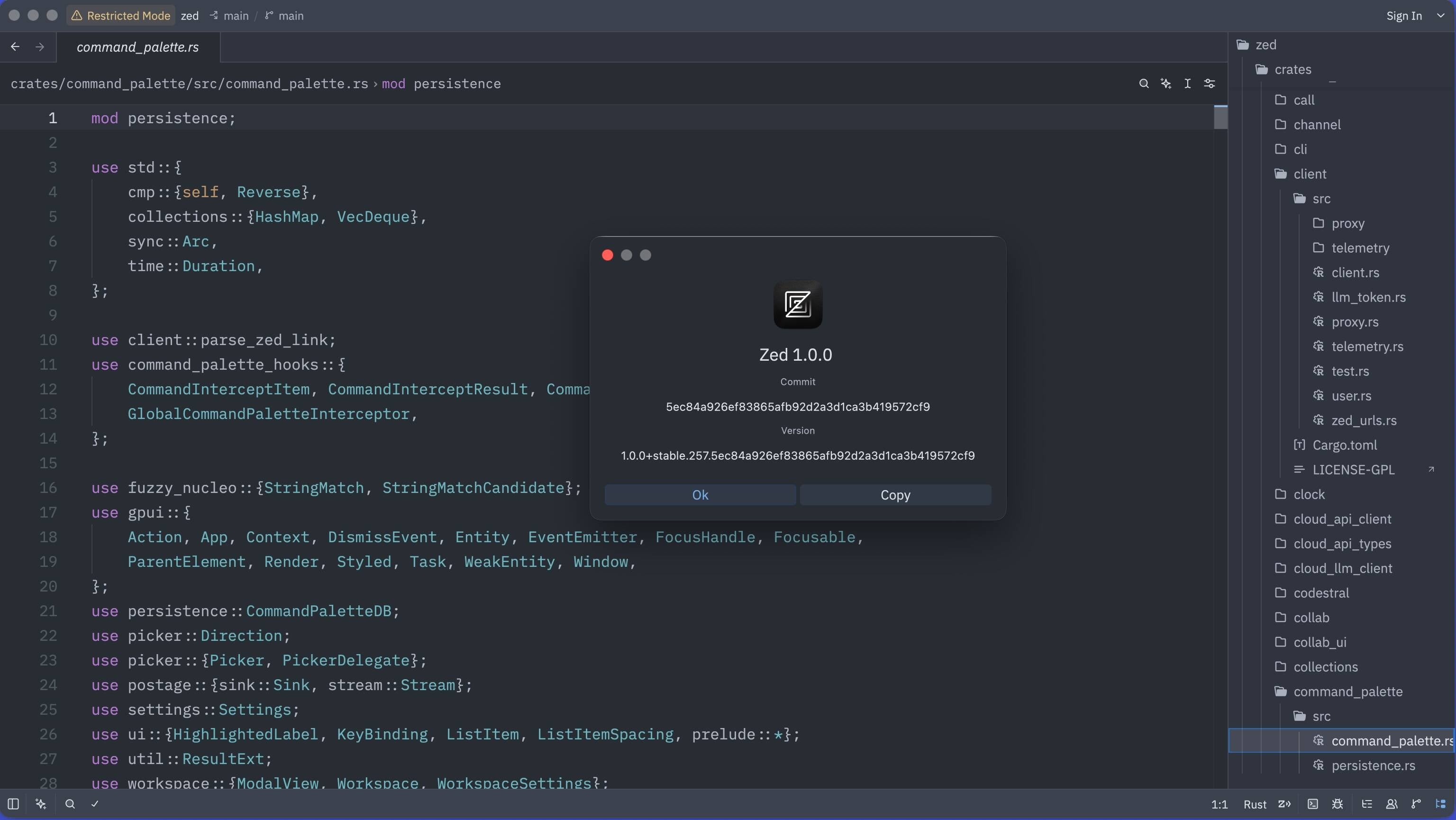
Zed version 1.0 has been released (click to enlarge)
Nathan Sobo, CEO and co-founder of Zed Industries, said that Zed is neither done nor perfect, but has "reached a tipping point where most developers can feel quickly at home."
Sobo worked on Atom and Electron - the Chromium-based framework used by both Atom and Microsoft's Visual Studio Code (VS Code) - during nine years at GitHub from December 2011. He now says that web technology offered "an easy path to shipping" but also limited performance and capabilities.
The version 1.0 release is mainly bug-fixes but also has new features including bookmarks, which enable quick navigation to bookmarked text, and a "view commit" command palette action for Git.
Zed 1.0 is available for macOS, Windows and Linux. Syntax highlighting and code completions are available for a wide range of languages, based on language server extensions, and with optional AI edit predictions from Zed's Zeta LLM (large language model) or external providers. LSPs for several languages, including C, C++, CSS, JavaScript, TypeScript, Markdown and Python, are built-in, with others available as language server extensions.
Extension availability may be a problem for VS Code switchers. Zed has only 1,000 extensions at the time of writing, whereas the VS Code marketplace has over 100,000.
Zed is developed using Rust, chosen for its combination of low-level control and expressiveness, and uses a custom GPU-accelerated UI (user interface) framework called GPUI, which like the rest of the code is open source on GitHub under the Apache 2 license.
Zed was first previewed in March 2023, for Mac only. There was no mention of AI in the introductory post; rather the focus was on performance and collaboration. Nevertheless, GitHub Copilot support was added a month later; and in August 2024 the team announced Zed AI, a collaboration with Anthropic. Next up was AI agents, with the team working with Google and JetBrains on the Agent Client Protocol (ACP), an attempt to standardize how agents communicate with editors.
In January this year, the team stated that it was "working with AI agents as part of our daily workflow," and earlier this month added a parallel agents feature to the editor, enabling multiple agents to work concurrently. Despite the move towards AI, the team won praise for adding a "disable all AI features" setting, for developers who want the code editor to be only a code editor.
Developers generally like Zed for its design and performance, although it is not really lightweight despite use of native code. "Zed is everything I wanted Sublime to be. Honestly, I wanted VS Code but fully native, and I feel like that's what I'm getting from Zed," said one on the HackerNews forum. Sublime is another popular editor, though it is not open source. Immaturity of some of the extensions and language support is a common complaint. There is also concern about Zed downloading and running packages including Node.js without specific user consent.
- Vite team boasts 10-30x faster builds with Rust-powered Rolldown
- JetBrains launches AI agent IDE built on the corpse of abandoned Fleet
- Gram: Zed, but with AI and chat features removed
- AWS backs Open VSX as Rust survey shows VS Code decline
Zed will no doubt improve, though competing with the huge VS Code ecosystem is a challenge. Another key question is how much focus the team puts on AI features. Many of Zed's characteristics are appealing to developers looking for a traditional code editor, despite the team's efforts to present Zed as an AI tool. At JetBrains, head of AI on IDE Denis Shiryaev blogged this week about the problem, stating that developers now have two ways to create code, meaning that IDEs have to morph between being a tool focused on code writing, and a tool for delegating tasks to AI. It is hard to do both well in one product.
Others argue that traditional IDEs are becoming obsolete. Test-driven development pioneer Kent Beck said that IDEs should now be optimized for code review, not code creation; while AI advocate Steve Yegge said recently, in answer to a question about IDEs, that "code is a liquid. You spray it through hoses. You don't freaking look at it." Fortunately for Zed, Yegge's view is not one that many developers share. ®