AI Navigate

Turbo Pascal 3.02A, deconstructed

Simon Willison's Blog / 3/21/2026

💬 OpinionIdeas & Deep AnalysisTools & Practical Usage

Key Points

  • The post chronicles tracking down a freeware Turbo Pascal 3.02A binary and using Claude to interpret and decompile it for educational purposes.
  • It presents an interactive artifact that embeds the full binary and displays it as labeled segments, a memory map, and annotated, readable code.
  • The author shares the exact prompts and workflow used with Claude, illustrating how AI can aid exploration of vintage software internals.
  • An infographic accompanies the piece, showing that Turbo Pascal 3.02A is 39,731 bytes with 17 mapped segments, a single 21H interrupt instruction, and 100+ built-in identifiers.
  • The article situates the project in historical context by referencing James Hague’s 2011 list of things larger than Turbo Pascal 3.02A and the claim that the binary contains a built-in editor and compiler.
Sponsored by: WorkOS — The infrastructure fast-growing B2B companies use to sell to Enterprise.

20th March 2026 - Link Blog

Turbo Pascal 3.02A, deconstructed. In Things That Turbo Pascal is Smaller Than James Hague lists things (from 2011) that are larger in size than Borland's 1985 Turbo Pascal 3.02 executable - a 39,731 byte file that somehow included a full text editor IDE and Pascal compiler.

This inspired me to track down a copy of that executable (available as freeware since 2000) and see if Claude could interpret the binary and decompile it for me.

It did a great job, so I had it create this interactive artifact illustrating the result. Here's the sequence of prompts I used (in regular claude.ai chat, not Claude Code):

Read this https://prog21.dadgum.com/116.html

Now find a copy of that binary online

Explore this (I attached the zip file)

Build an artifact - no react - that embeds the full turbo.com binary and displays it in a way that helps understand it - broke into labeled segments for different parts of the application, decompiled to visible source code (I guess assembly?) and with that assembly then reconstructed into readable code with extensive annotations
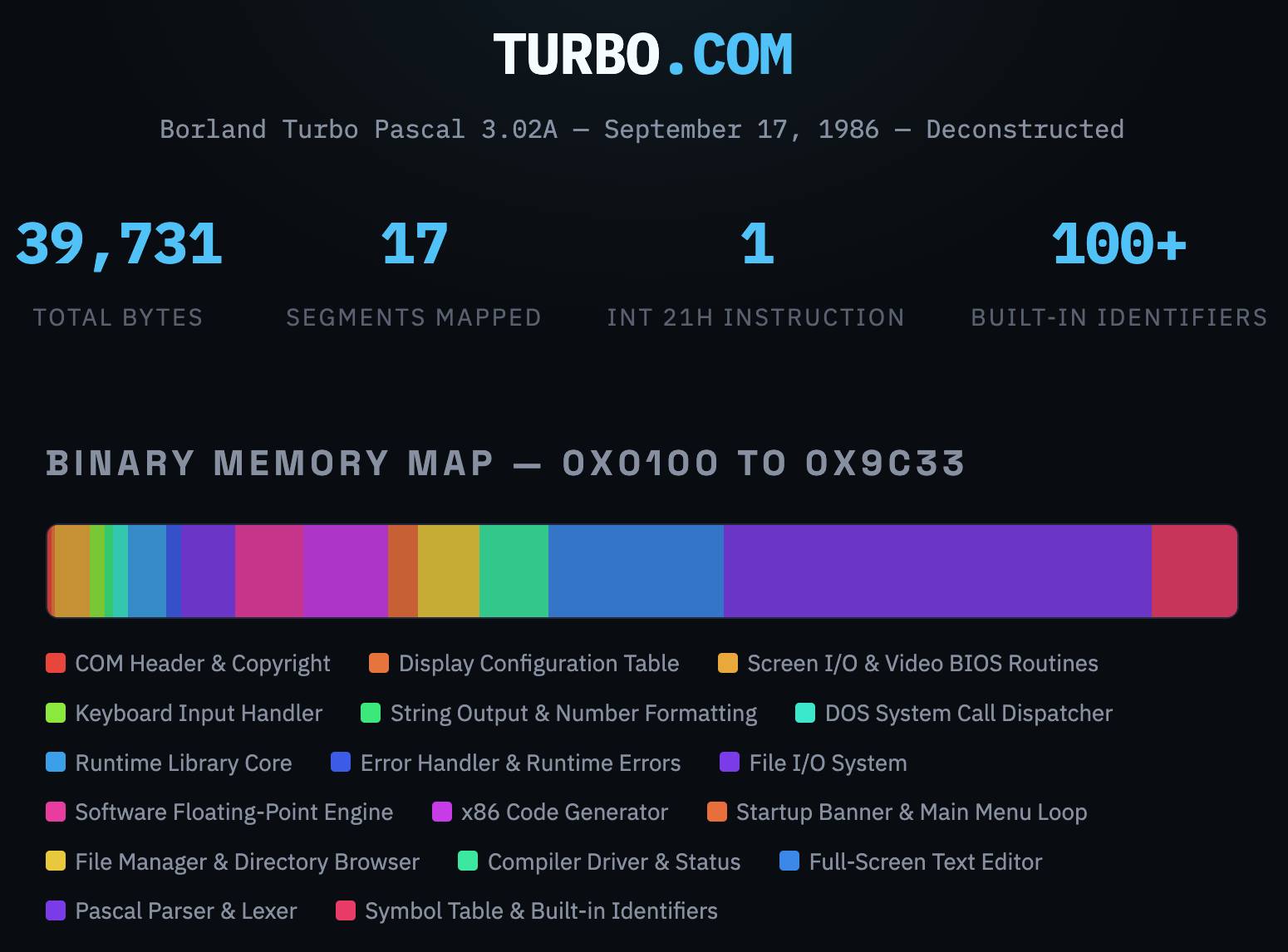
Infographic titled "TURBO.COM" with subtitle "Borland Turbo Pascal 3.02A — September 17, 1986 — Deconstructed" on a dark background. Four statistics are displayed: 39,731 TOTAL BYTES, 17 SEGMENTS MAPPED, 1 INT 21H INSTRUCTION, 100+ BUILT-IN IDENTIFIERS. Below is a "BINARY MEMORY MAP — 0X0100 TO 0X9C33" shown as a horizontal color-coded bar chart with a legend listing 17 segments: COM Header & Copyright, Display Configuration Table, Screen I/O & Video BIOS Routines, Keyboard Input Handler, String Output & Number Formatting, DOS System Call Dispatcher, Runtime Library Core, Error Handler & Runtime Errors, File I/O System, Software Floating-Point Engine, x86 Code Generator, Startup Banner & Main Menu Loop, File Manager & Directory Browser, Compiler Driver & Status, Full-Screen Text Editor, Pascal Parser & Lexer, and Symbol Table & Built-in Identifiers.

Posted 20th March 2026 at 11:59 pm

This is a link post by Simon Willison, posted on 20th March 2026.

computer-history 16 tools 52 ai 1921 generative-ai 1703 llms 1669 claude 262

Monthly briefing

Sponsor me for $10/month and get a curated email digest of the month's most important LLM developments.

Pay me to send you less!

Sponsor & subscribe