
 | In the rapidly advancing field of materials science, the unveiling of innovative research directions often hinges on the ability to process and interpret vast quantities of complex data. In a groundbreaking interdisciplinary effort, researchers have now harnessed the power of large language models (LLMs) combined with concept graphs to not only predict but also elucidate emerging pathways in materials research. This novel methodological synergy, reported in a recent publication by Marwitz et al., represents a significant leap forward in how scientific knowledge is generated and navigated, promising to accelerate discovery in one of the most pivotal domains of modern technology. The integration of artificial intelligence into scientific inquiry is not new, but the advent of sophisticated language models possessing superlative natural language processing capabilities has opened unprecedented possibilities. Traditionally, the identification of promising research avenues in materials science required painstaking manual synthesis of literature, often involving subjective interpretations and laborious cross-referencing. The approach introduced by Marwitz and colleagues redefines this process by employing LLMs trained on an extensive corpus of scientific publications and patents to parse nuanced semantic relationships within the literature. Central to their method is the construction of concept graphs, which serve as structured networks that represent discrete scientific concepts and their interrelations. These graph-based representations enable the system to encapsulate intricate thematic connections, causal relationships, and co-occurrence patterns that conventional keyword-based searches or citation networks might overlook. By interfacing LLM-generated embeddings with concept graph algorithms, the researchers created an intelligent framework capable of discerning latent trends and forecasting underexplored yet promising research directions. A key innovation lies in the algorithmic fusion of contextual language understanding with graph theory. The LLMs transform textual data into multidimensional vector spaces that preserve semantic meaning. These vectors populate nodes and edges within the concept graphs, generating a dynamic knowledge map that evolves as new data is ingested. This fusion not only enriches the representation of existing knowledge but also facilitates the identification of conceptual gaps wherein novel hypotheses or experimental approaches may reside. Applying their system to a comprehensive dataset encompassing decades of materials science literature, Marwitz et al. demonstrated the ability to uncover nascent themes with high predictive accuracy. For example, their model anticipated burgeoning interest in the design of ultra-stable perovskite structures and advanced polymer electrolytes months before these topics gained traction in the research community. Such foresight provides scientists and funding bodies with actionable intelligence to strategically allocate resources, prioritize research programs, and foster interdisciplinary collaboration. Beyond prediction, the system offers interpretability, a feature often lacking in AI-driven scientific tools. Through interactive visualizations of concept graphs, domain experts can explore the rationale behind suggested research trajectories, trace conceptual linkages, and even assess the robustness of emergent hypotheses against existing knowledge. This transparency is critical for fostering trust and facilitating adoption in a community where empirical validation remains the gold standard. The implications of this study extend far beyond materials science. The demonstrated methodology, leveraging LLMs and concept graphs, can be adapted to numerous scientific disciplines characterized by rapidly expanding and complex data landscapes. From drug discovery to climate modeling, this approach could revolutionize how researchers navigate vast knowledge repositories, identify opportunities for innovation, and catalyze breakthroughs. Moreover, the study aligns with the broader trend towards augmented intelligence, where machine learning complements rather than replaces human expertise. By automating the labor-intensive aspects of literature review and hypothesis generation, researchers can devote more attention to experimental design, critical analysis, and creative problem-solving—the uniquely human contributions essential for scientific progress. [link] [comments] |
New Research Directions in Materials Science with AI
Reddit r/artificial / 4/2/2026
💬 OpinionSignals & Early TrendsIdeas & Deep AnalysisModels & Research
Key Points
- Researchers (Marwitz et al.) propose a new materials-science discovery workflow that combines large language models (LLMs) with concept graphs to predict and explain emerging research directions.
- The method addresses limitations of manual literature review by using LLMs trained on scientific publications and patents to extract nuanced semantic relationships.
- Concept graphs provide structured networks of scientific concepts and their interrelations, enabling detection of latent trends and underexplored pathways beyond keyword or citation-based approaches.
- By fusing LLM embeddings with graph algorithms, the system creates a dynamic “knowledge map” that can update as new data is added and highlight conceptual gaps for new hypotheses.
- The approach is positioned as a step toward accelerating materials discovery by making knowledge generation and navigation more systematic and less subjective.
Related Articles

Black Hat Asia
AI Business
v5.5.0
Transformers(HuggingFace)Releases
Bonsai (PrismML's 1 bit version of Qwen3 8B 4B 1.7B) was not an aprils fools joke
Reddit r/LocalLLaMA

Big Tech firms are accelerating AI investments and integration, while regulators and companies focus on safety and responsible adoption.
Dev.to
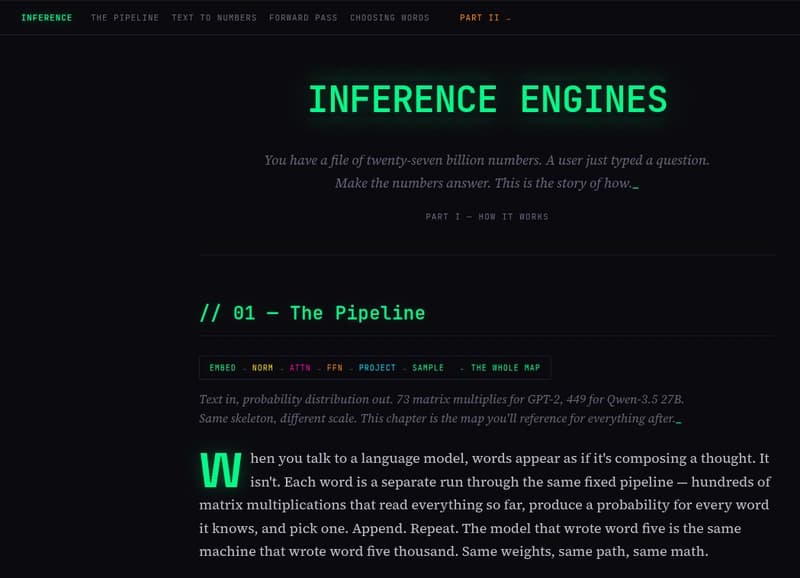
Inference Engines - A visual deep dive into the layers of an LLM
Dev.to


