
Fast-dVLA: Accelerating Discrete Diffusion VLA to Real-Time Performance
arXiv cs.RO / 3/27/2026
💬 OpinionSignals & Early TrendsIdeas & Deep AnalysisModels & Research
Key Points
- The paper introduces “Fast-dVLA,” a method aimed at improving pretrained VLA performance and lowering adaptation cost during standard supervised finetuning (SFT) without relying on heavy auxiliary losses.
- It decouples auxiliary training goals in parameter space—separating general capability enhancement from task-specific action distribution fitting—by deriving “capability vectors” from small-scale task convergence runs.
- The capability vectors are merged with pretrained parameters to form a capability-enhanced meta model, intended to capture auxiliary-task benefits more efficiently.
- The approach further adds a lightweight orthogonal regularization term to augmented standard SFT to achieve results comparable to auxiliary finetuned baselines while reducing computational overhead.
- Experiments reportedly show strong effectiveness across a variety of robot tasks, suggesting the method generalizes beyond a single benchmark.
広告
Related Articles
Got My 39-Agent System Audited Live. Here's What the Maturity Scorecard Revealed.
Dev.to
The Redline Economy
Dev.to
$500 GPU outperforms Claude Sonnet on coding benchmarks
Dev.to
From Scattershot to Sniper: AI for Hyper-Personalized Media Lists
Dev.to
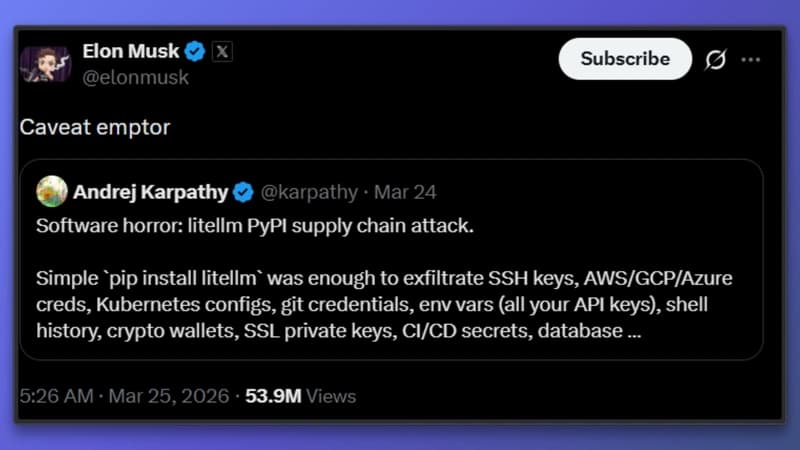
The LiteLLM Supply Chain Attack: A Wake-Up Call for AI Infrastructure
Dev.to


