
Learning Zero-Shot Subject-Driven Video Generation Using 1% Compute
arXiv cs.CV / 5/6/2026
📰 NewsDeveloper Stack & InfrastructureModels & Research
Key Points
- The paper tackles subject-driven video generation by proposing a zero-shot approach that avoids per-subject tuning and does not require large-scale subject–video training pairs.
- It decomposes the task into learning subject identity injection from subject-image pairs and preserving motion characteristics using only a small set of arbitrary videos.
- The method uses stochastic optimization with random reference-frame sampling and image-token dropout to reduce trivial first-frame copying and improve generalization.
- Experiments with CogVideoX-5B show that adapting a single model with 200K subject-image pairs and 4,000 arbitrary videos can be done in 288 A100 GPU hours—about 1% of the compute of prior zero-shot baselines—while remaining competitive on subject fidelity and motion quality.
- The authors report that the same recipe also transfers to Wan 2.2-5B, suggesting broader applicability across video generation model families.
Related Articles

SIFS (SIFS Is Fast Search) - local code search for coding agents
Dev.to
BizNode's semantic memory (Qdrant) makes your bot smarter over time — it remembers past conversations and answers...
Dev.to
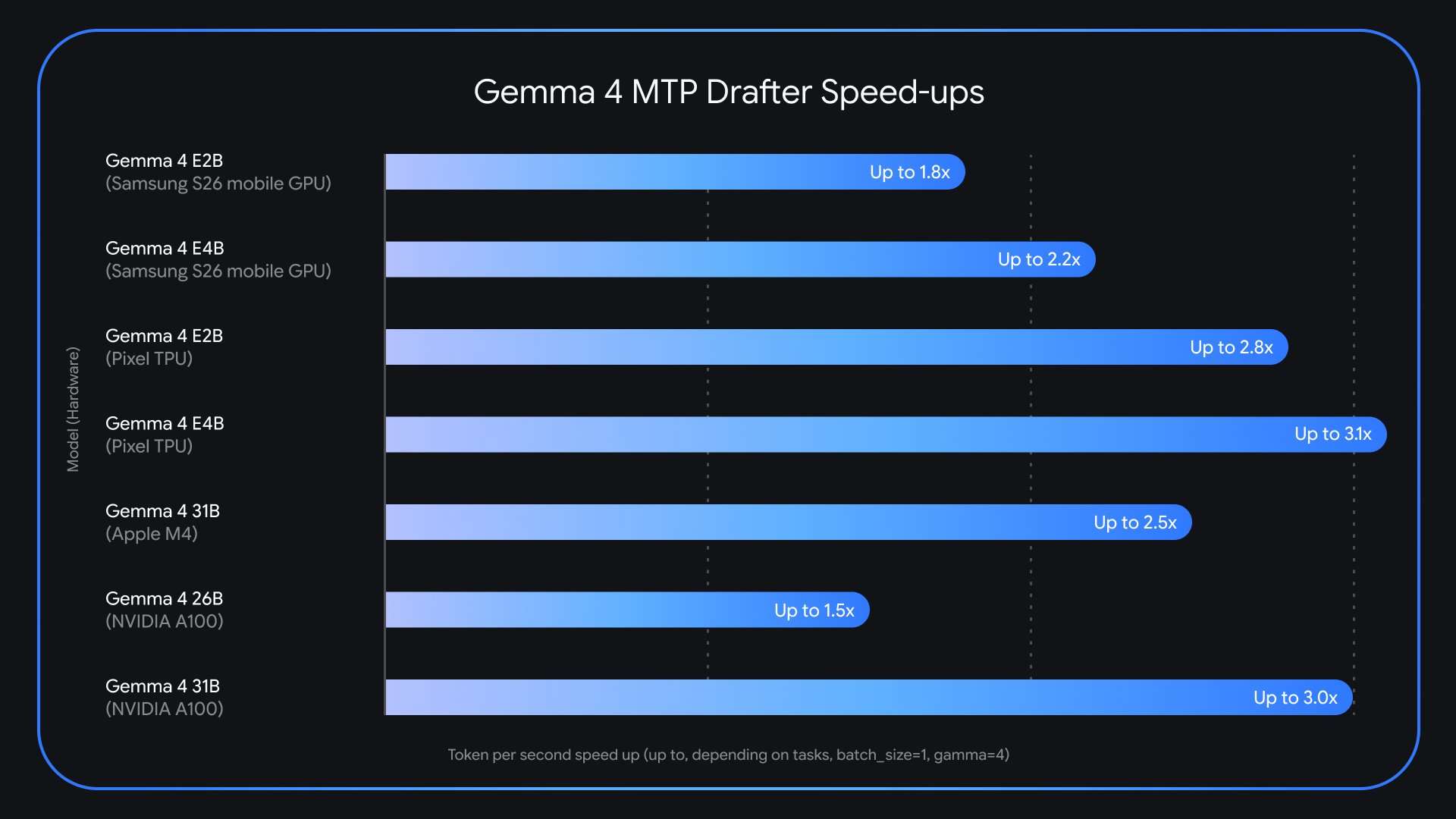
Google AI Releases Multi-Token Prediction (MTP) Drafters for Gemma 4: Delivering Up to 3x Faster Inference Without Quality Loss
MarkTechPost
Solidity LM surpasses Opus
Reddit r/LocalLLaMA

Quality comparison between Qwen 3.6 27B quantizations (BF16, Q8_0, Q6_K, Q5_K_XL, Q4_K_XL, IQ4_XS, IQ3_XXS,...)
Reddit r/LocalLLaMA


