
Execution-Verified Reinforcement Learning for Optimization Modeling
arXiv cs.AI / 4/2/2026
💬 OpinionSignals & Early TrendsIdeas & Deep AnalysisModels & Research
Key Points
- The paper introduces Execution-Verified Optimization Modeling (EVOM), a closed-loop framework that uses a mathematical programming solver as a deterministic verifier for LLM-generated solver-specific code.
- EVOM converts sandboxed execution outcomes into scalar rewards and trains via GRPO and DAPO, avoiding costly process-level supervision that can overfit to a single solver API.
- By switching the verification environment (solver backend) rather than rebuilding solver-specific datasets, EVOM targets cross-solver generalization and zero-shot solver transfer.
- Experiments across multiple optimization benchmarks (NL4OPT, MAMO, IndustryOR, OptiBench) and solver backends (Gurobi, OR-Tools, COPT) show EVOM matches or outperforms process-supervised SFT and supports low-cost adaptation by continuing training under a target solver.
- The work positions execution-verified reinforcement learning as an alternative path to “scalable decision intelligence” using LLMs for automated optimization modeling.
Related Articles

Black Hat Asia
AI Business
v5.5.0
Transformers(HuggingFace)Releases
Bonsai (PrismML's 1 bit version of Qwen3 8B 4B 1.7B) was not an aprils fools joke
Reddit r/LocalLLaMA
Big Tech firms are accelerating AI investments and integration, while regulators and companies focus on safety and responsible adoption.
Dev.to
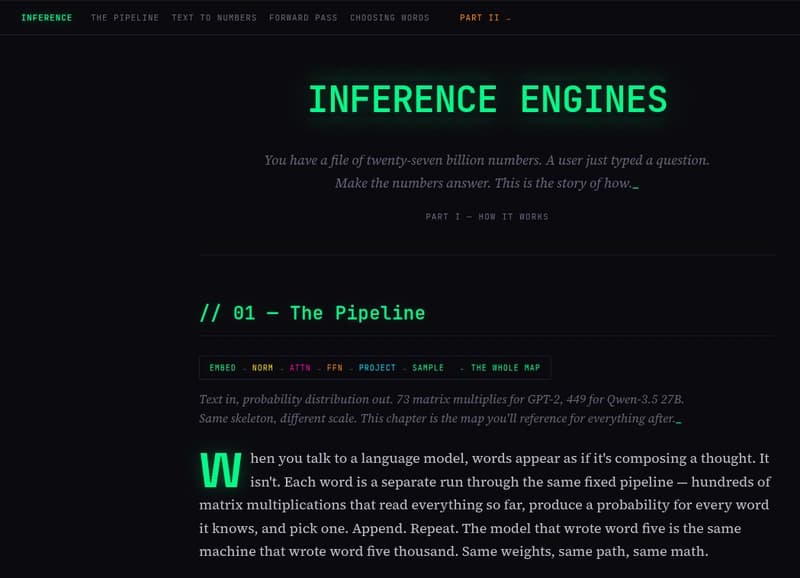
Inference Engines - A visual deep dive into the layers of an LLM
Dev.to


