
Large Language Model as Token Compressor and Decompressor
arXiv cs.CL / 3/27/2026
💬 OpinionSignals & Early TrendsIdeas & Deep AnalysisModels & Research
Key Points
- The paper proposes that an off-the-shelf large language model (LLM) can serve as both a token compressor and decompressor by learning an internal representation.
- It introduces a self-expressive autoencoding framework that fine-tunes a pretrained LLM to convert long text into discrete, variable-length latent codes (“Z-tokens”) and reconstruct the original text exactly.
- The learned Z-token representation is content-adaptive, allocating more tokens to semantically dense segments while aggressively compressing redundant or predictable regions using lightweight LoRA-based adapter heads.
- Experiments report up to 18× token reduction on datasets such as Wikipedia, CNN/DailyMail, HotpotQA, and long-query corpora, while maintaining reconstruction fidelity and downstream task performance.
- The approach is positioned as enabling token-efficient long-context reasoning, including prompt compression and autoregressive generation directly in the Z-token space.
広告
Related Articles

Got My 39-Agent System Audited Live. Here's What the Maturity Scorecard Revealed.
Dev.to

The Redline Economy
Dev.to

$500 GPU outperforms Claude Sonnet on coding benchmarks
Dev.to

From Scattershot to Sniper: AI for Hyper-Personalized Media Lists
Dev.to
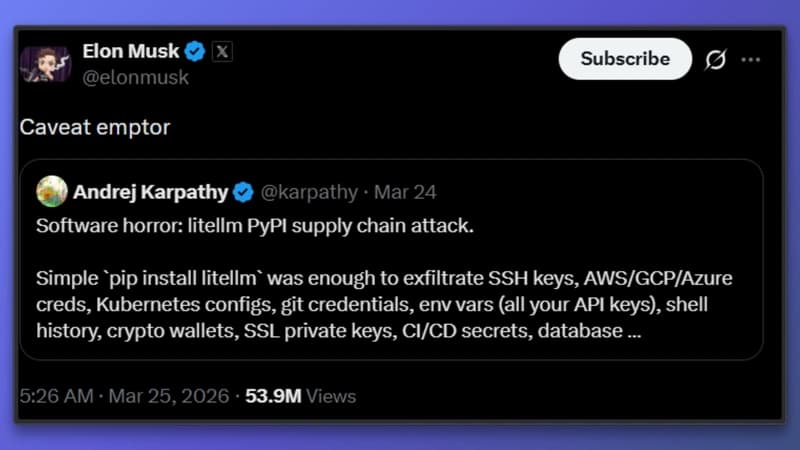
The LiteLLM Supply Chain Attack: A Wake-Up Call for AI Infrastructure
Dev.to


