
Efficient Deconvolution in Populational Inverse Problems
arXiv stat.ML / 5/6/2026
💬 OpinionIdeas & Deep AnalysisModels & Research
Key Points
- The paper addresses distributional inversion problems where one must infer the parameter distribution underlying a physical process from multiple noisy observation sets.
- It tackles the key obstacle of blind deconvolution when the observational noise distribution is unknown, arguing that population-level data from repeated physical instantiations can make deconvolution feasible.
- The authors introduce a coupled optimization framework that simultaneously estimates the parameter distribution and the unknown noise distribution by minimizing a loss that compares observed data to outputs of a parameter-dependent physical model.
- They develop a modified gradient-descent method that exploits structure in the noise model, and they add an active-learning strategy to train a surrogate model focused on parameter regions of interest.
- The method is evaluated on several examples—including porous medium flow, damped elastodynamics, and simplified atmospheric dynamics—showing its ability to accelerate computation and support automatic differentiation even for black-box (possibly nondifferentiable) solvers.
Related Articles

Top 10 Free AI Tools for Students in 2026: The Ultimate Study Guide
Dev.to

AI as Your Contingency Co-Pilot: Automating Wedding Day 'What-Ifs'
Dev.to
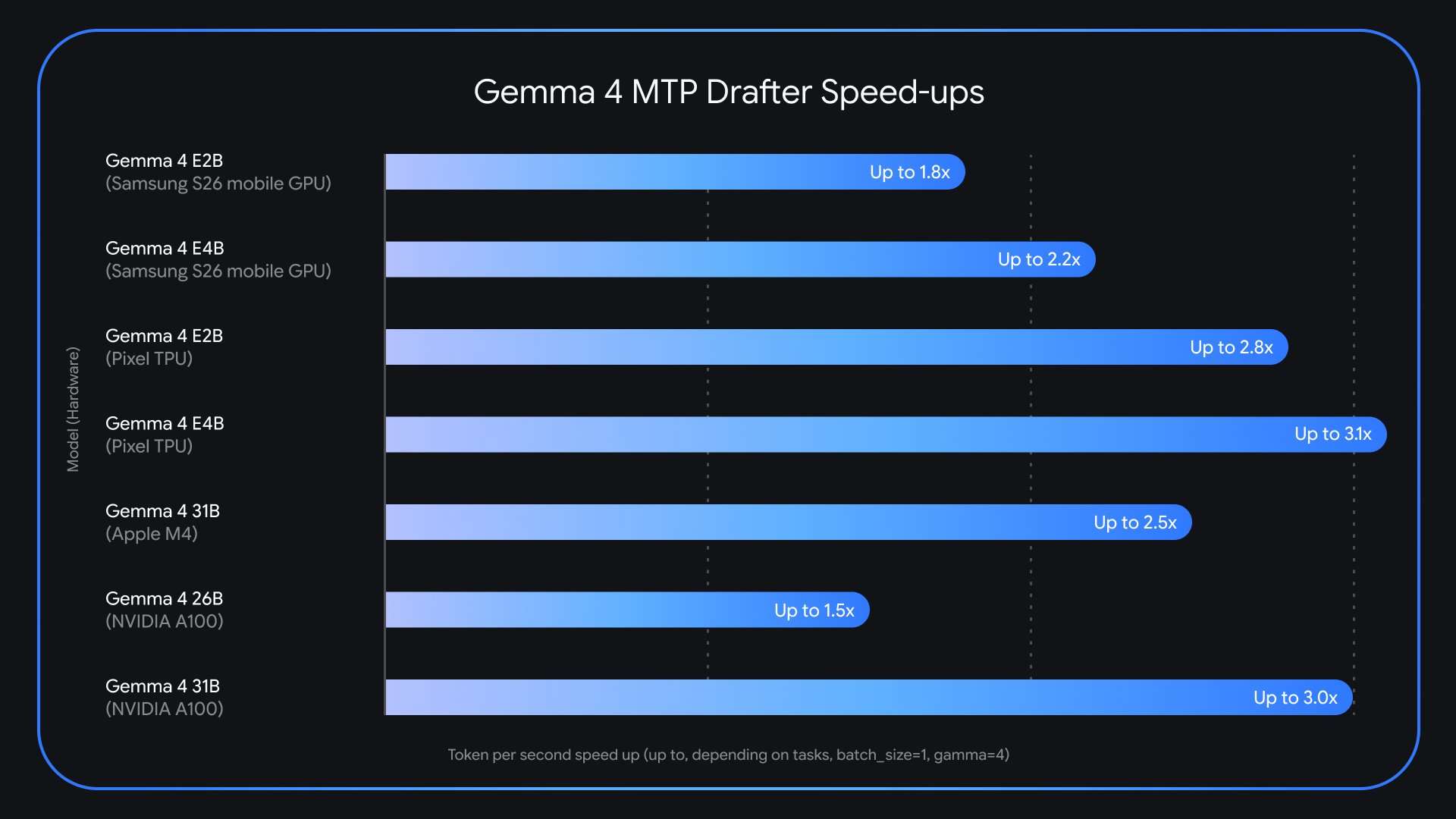
Google AI Releases Multi-Token Prediction (MTP) Drafters for Gemma 4: Delivering Up to 3x Faster Inference Without Quality Loss
MarkTechPost
When Claude Hallucinates in Court: The Latham & Watkins Incident and What It Means for Attorney Liability
MarkTechPost
Solidity LM surpasses Opus
Reddit r/LocalLLaMA


