
Kernel Affine Hull Machines for Compute-Efficient Query-Side Semantic Encoding
arXiv cs.LG / 5/6/2026
📰 NewsDeveloper Stack & InfrastructureIdeas & Deep AnalysisModels & Research
Key Points
- The paper tackles semantic retrieval settings where the online cost is dominated by query-side transformer encoding, proposing a way to avoid repeated neural inference.
- It introduces Kernel Affine Hull Machines (KAHMs), which estimate prototype-mixture weights using a rigorously defined RKHS and refine prototypes via normalized least-mean-squares to map cheap lexical features into a frozen teacher embedding space.
- The method provides an analytically explicit decomposition of encoding error into posterior approximation, generalization, and teacher-noise components, improving interpretability.
- On an Austrian-law benchmark (5,000 queries), KAHMs match or outperform comparable learned query adapters in teacher-space reconstruction (MSE 0.000091, R² 0.9071, cosine 0.9536).
- KAHMs also improve rank-based retrieval metrics (MRR@20 0.504, Hit@20 0.694, Top-1 0.411) and cut per-query latency by 8.5× versus direct transformer encoding.
Related Articles

Top 10 Free AI Tools for Students in 2026: The Ultimate Study Guide
Dev.to

SIFS (SIFS Is Fast Search) - local code search for coding agents
Dev.to

AI as Your Contingency Co-Pilot: Automating Wedding Day 'What-Ifs'
Dev.to

BizNode's semantic memory (Qdrant) makes your bot smarter over time — it remembers past conversations and answers...
Dev.to
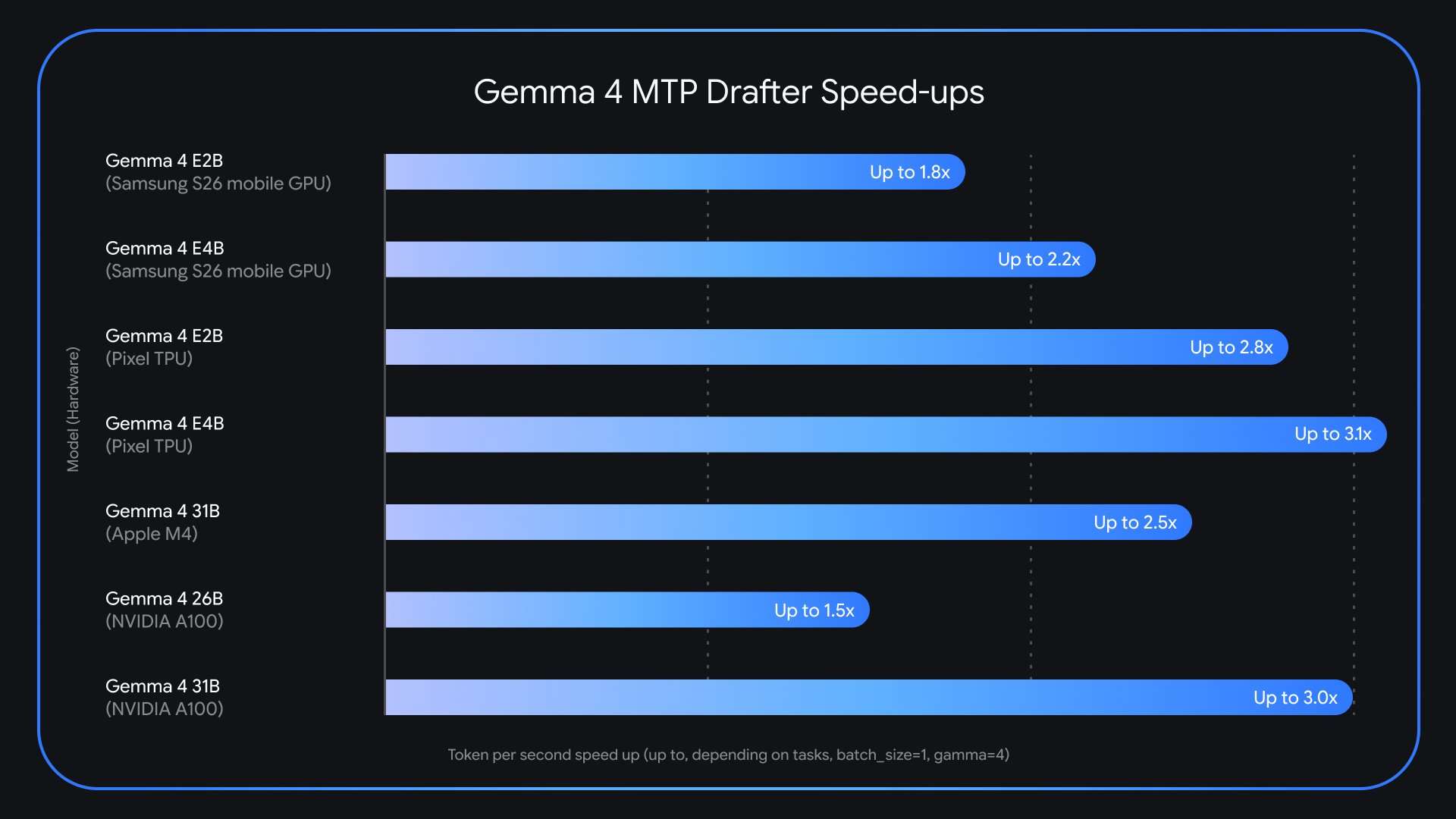
Google AI Releases Multi-Token Prediction (MTP) Drafters for Gemma 4: Delivering Up to 3x Faster Inference Without Quality Loss
MarkTechPost


