
Flow-Opt: Scalable Centralized Multi-Robot Trajectory Optimization with Flow Matching and Differentiable Optimization
arXiv cs.RO / 4/21/2026
📰 NewsDeveloper Stack & InfrastructureSignals & Early TrendsModels & Research
Key Points
- Flow-Opt presents a learning-based method to make centralized multi-robot joint-space trajectory optimization computationally tractable, especially in cluttered, tight environments.
- The approach learns a generative model (a flow-matching model using a diffusion transformer with permutation-invariant robot and map encoders) to sample diverse candidate trajectories, then applies a learned Safety-Filter to satisfy constraints quickly at inference time.
- Flow-Opt includes a custom Safety-Filter solver enhanced with a neural initialization network trained in a self-supervised way by leveraging the differentiability of the solver.
- Experiments report generating collision-avoidant, smooth trajectories for tens of robots in tens of milliseconds, outperforming prior centralized optimization and achieving much faster smoothness than diffusion-model baselines.
- The system is designed to be efficiently batched, enabling solutions for dozens of problem instances within fractions of a second and producing a diverse set of behaviors between fixed start/goal pairs.
Related Articles
A practical guide to getting comfortable with AI coding tools
Dev.to
Competitive Map: 10 AI Agent Platforms vs AgentHansa
Dev.to

Every time a new model comes out, the old one is obsolete of course
Reddit r/LocalLLaMA
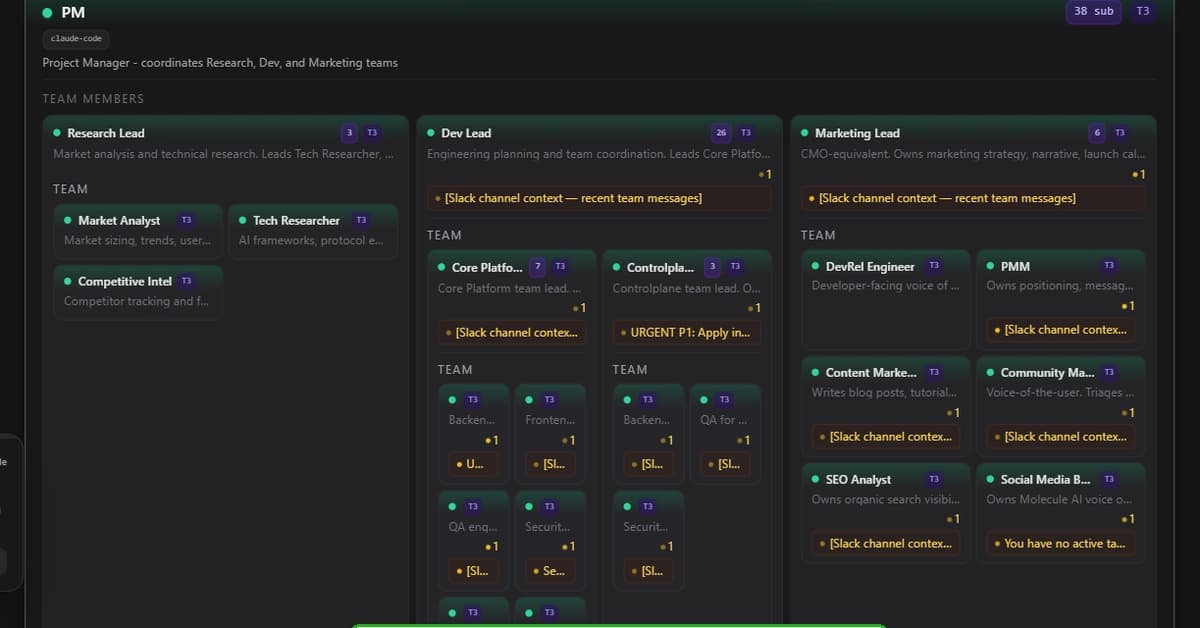
We built it during the NVIDIA DGX Spark Full-Stack AI Hackathon — and it ended up winning 1st place overall 🏆
Dev.to

Stop Losing Progress: Setting Up a Pro Jupyter Workflow in VS Code (No More Colab Timeouts!)
Dev.to


