
Uncertainty-Guided Label Rebalancing for CPS Safety Monitoring
arXiv cs.LG / 3/27/2026
📰 NewsSignals & Early TrendsIdeas & Deep AnalysisModels & Research
Key Points
- The paper addresses extreme class imbalance in safety monitoring for Cyber-Physical Systems (CPSs), where unsafe events are rare and standard rebalancing methods struggle with time-series telemetry data.
- It introduces U-Balance, which first trains a GatedMLP-based uncertainty predictor over telemetry windows to compute a behavioral uncertainty score linked to safety outcomes.
- U-Balance then uses an uncertainty-guided label rebalancing (uLNR) strategy that probabilistically relabels high-uncertainty safe windows as unsafe to enrich informative boundary samples without generating synthetic data.
- Experiments on a large-scale UAV benchmark with a 46:1 safe-to-unsafe ratio show behavioral uncertainty correlates with safety and that uLNR is more effective than alternative uncertainty fusion approaches.
- U-Balance achieves a 0.806 F1 score, outperforming the best baseline by 14.3 percentage points while keeping inference efficiency competitive, with ablation results confirming contributions from both uncertainty prediction and uLNR.
広告
Related Articles

Got My 39-Agent System Audited Live. Here's What the Maturity Scorecard Revealed.
Dev.to

The Redline Economy
Dev.to

$500 GPU outperforms Claude Sonnet on coding benchmarks
Dev.to

From Scattershot to Sniper: AI for Hyper-Personalized Media Lists
Dev.to
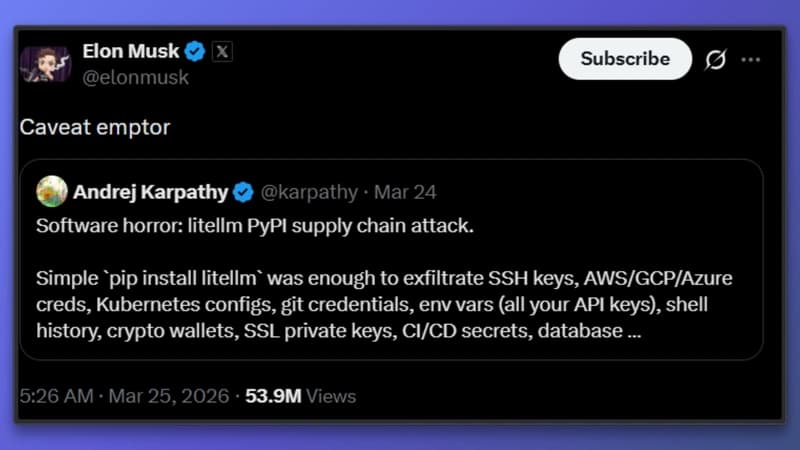
The LiteLLM Supply Chain Attack: A Wake-Up Call for AI Infrastructure
Dev.to


