
Plagiarism or Productivity? Students Moral Disengagement and Behavioral Intentions to Use ChatGPT in Academic Writing
arXiv cs.AI / 3/23/2026
💬 OpinionIdeas & Deep AnalysisModels & Research
Key Points
- The study identifies five moral disengagement mechanisms—moral justification, euphemistic labeling, displacement of responsibility, minimizing consequences, and attribution of blame—as predictors of Filipino college students' attitudes, subjective norms, and perceived behavioral control toward using ChatGPT in academic writing.
- Among these mechanisms, attribution of blame has the strongest influence on attitudes and perceived control, making it a key driver of students' behavioral intention to use ChatGPT.
- Attitudes toward using ChatGPT are the most powerful predictor of behavioral intention, and the model explains more than half of the variance in intention.
- The findings suggest that institutional gaps and unclear rules help justify AI use, underscoring the need for clear academic integrity policies, ethical guidance, and classroom support, while noting that intention-based models may not fully capture student behavior.
広告
Related Articles

Got My 39-Agent System Audited Live. Here's What the Maturity Scorecard Revealed.
Dev.to

The Redline Economy
Dev.to

$500 GPU outperforms Claude Sonnet on coding benchmarks
Dev.to

From Scattershot to Sniper: AI for Hyper-Personalized Media Lists
Dev.to
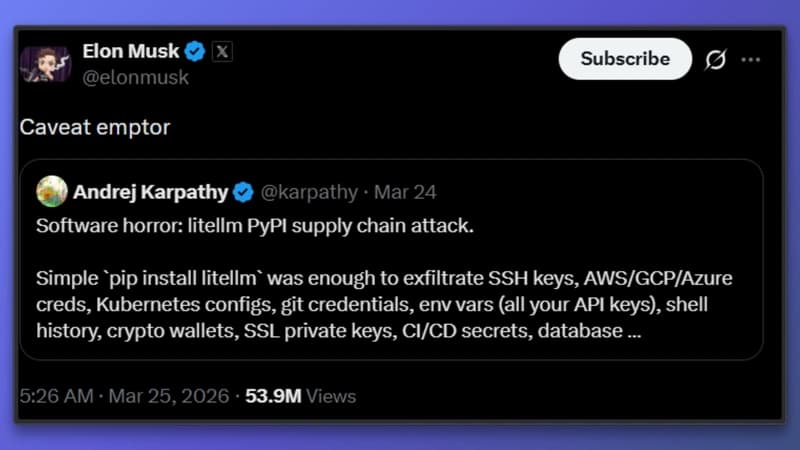
The LiteLLM Supply Chain Attack: A Wake-Up Call for AI Infrastructure
Dev.to


