Headless 360: Salesforce's latest pitch to let AI do the dev work
Here comes 'enterprise vibe coding' as CRM giant aims to open development to anyone on the platform


Salesforce has introduced what it calls Headless 360 at its developer event TDX, which starts today in San Francisco, designed to expand the reach of its app-building tools beyond traditional developers.
The goal of Headless 360 is that everything on the Salesforce platform is now an API (application programming interface), MCP (model context protocol) server, or CLI (command line interface) command able to be called by coding agents, or by custom agents targeting specific customer requirements.
The Salesforce platform includes CRM (customer relationship management), customer service, marketing, and ecommerce. The company also owns the Slack collaboration tool. Historically, the main UI (user interface) for Salesforce has been in the web browser, though it has always supported a comprehensive API. The company now prefers to talk about an "experience layer" where user interaction can be anywhere, including Slack, Teams, voice chat, ChatGPT, or a custom React application.
Headless 360 means that agentic AI in any development tool – including Claude Code, Codex, Windsurf, or Visual Studio Code – can build applications that target the Salesforce platform.
"The developer, the builder is talking to these tools, the tools are driving the Salesforce UI creation, configuration etc," said said Joe Inzerillo, Salesforce president of enterprise and AI technology. "We're trying to create this ecosystem where in the future most of the code is going to be written by the agents.
"We see that internally in the way that we write things, already there are systems where the vast majority of code is written by the agent," he added.
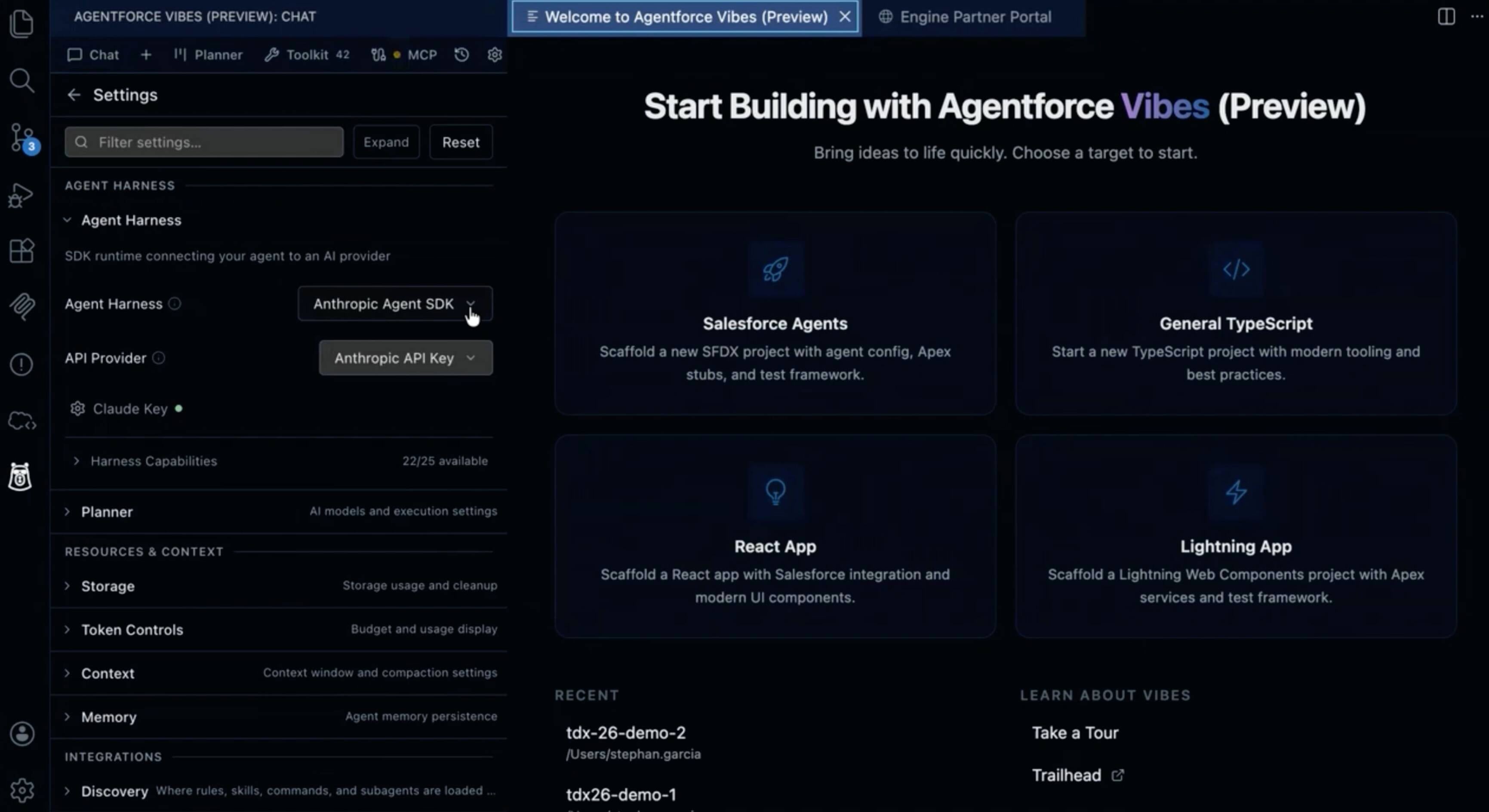
Agentforce Code, also known as Vibes, is a browser-based IDE for building agents or apps with AI
Agentforce Code, also known as Agentforce Vibes, is a browser-based IDE based on Visual Studio Code and is now available as part of the free Salesforce Developer Edition as well as paid subscriptions. There are new agentic integrations and it reflects the fact that some users will rely on agents to do the coding for them. Salesforce extensions, the Salesforce CLI, and organization metadata are all pre-configured.
The default LLM (large language model) in Agentforce Code is Claude Sonnet 4.5. It has two modes - plan mode and act mode - and comes with a set of pre-defined agent skills for tasks such as creating custom tabs in a UI (user interface) or generating Salesforce flows. Despite the flexibility of Headless 360, Agentforce Vibes defaults to coding with Apex, the Java-like programming language which is customized for Salesforce apps.
Salesforce has usage limits for its developer edition, set at 110 requests per month and 1.5 million tokens. These will refresh monthly until May 31, after which there is a final monthly allocation and no further refresh.
Salesforce is keen for companies to build custom agents, rather than just using them to build applications. The definition language for this is Agent Script, which, like Apex, is customized for Salesforce. Agent Script will now be open source, Salesforce said at the TDX conference.
However, the company also acknowledges that agents are "probabilistic, not deterministic," and that they "reason their way to unexpected outcomes," to quote the press release.
Salesforce has a set of tools intended to control unwanted behavior, including a testing center, observability and session tracing, and the ability to define guardrails and explicit business logic for some operations via Agent Script.
- GitHub invokes spirit of Phabricator with preview of Stacked PRs
- Claude Code cache chaos creates quota complaints
- Microsoft developer chief Julia Liuson is logging off
- Microsoft calls time on ASP.NET Core 2.3 on .NET Framework
The company also announced the Slack Agent Kit, a collection of tools designed to bring agents on any platform into Slack with a chat UI.
The story behind Headless 360 is that Salesforce has bought into the idea that most future coding will be done by agents rather than humans. The company said this is a response to customer demand.
The initiative is also explicitly designed to enable non-programmers to build on the platform. "We want to expand the tent to bring in people that historically have not been part of the Salesforce ecosystem, that now are starting to build capabilities on Salesforce. Headless is a fundamental unlock that allows people to use our systems more effectively," said Madhav Thattai, EVP and GM of Salesforce AI.
Most customers only use a small subset of the capabilities of the Salesforce platform, and per-user subscriptions are costly. What about the notion that with AI to assist the coding, companies can replace Salesforce with their own custom solutions built from scratch?
"Maybe you could vibe yourself a SaaS application but who's going to maintain it?" said Thattai. "The notion that every company is going to build everything that they need to use themselves seems pretty crazy because it's a huge amount of expense, time, energy, and brain power that companies are focusing on things that aren't their core business."
Other factors the company hopes will keep users on Salesforce include the built-in data structures and workflows that have evolved over the years for CRM, marketing, and other Salesforce use cases. Salesforce also argues that the platform's security features and trust boundaries can protect users from some of the risks of custom development, particularly when vibe coding means builders may not fully understand what they are creating. ®