
Discovering Reinforcement Learning Interfaces with Large Language Models
arXiv cs.LG / 5/6/2026
📰 NewsDeveloper Stack & InfrastructureModels & Research
Key Points
- The paper tackles the challenge of automatically discovering full reinforcement learning (RL) task interfaces—both observation mappings and reward functions—starting from raw simulator state.
- It proposes LIMEN, an LLM-guided evolutionary framework that generates candidate interfaces as executable programs and improves them iteratively using feedback from policy training.
- Experiments on discrete gridworld tasks and continuous control (including locomotion and manipulation) show that jointly evolving observations and rewards can succeed with only trajectory-level success metrics.
- The study finds that optimizing only the observation mapping or only the reward function fails in at least one domain, highlighting the importance of co-design.
- The authors argue that this automatic interface construction can significantly reduce manual engineering effort for new RL tasks.
Related Articles

SIFS (SIFS Is Fast Search) - local code search for coding agents
Dev.to
BizNode's semantic memory (Qdrant) makes your bot smarter over time — it remembers past conversations and answers...
Dev.to
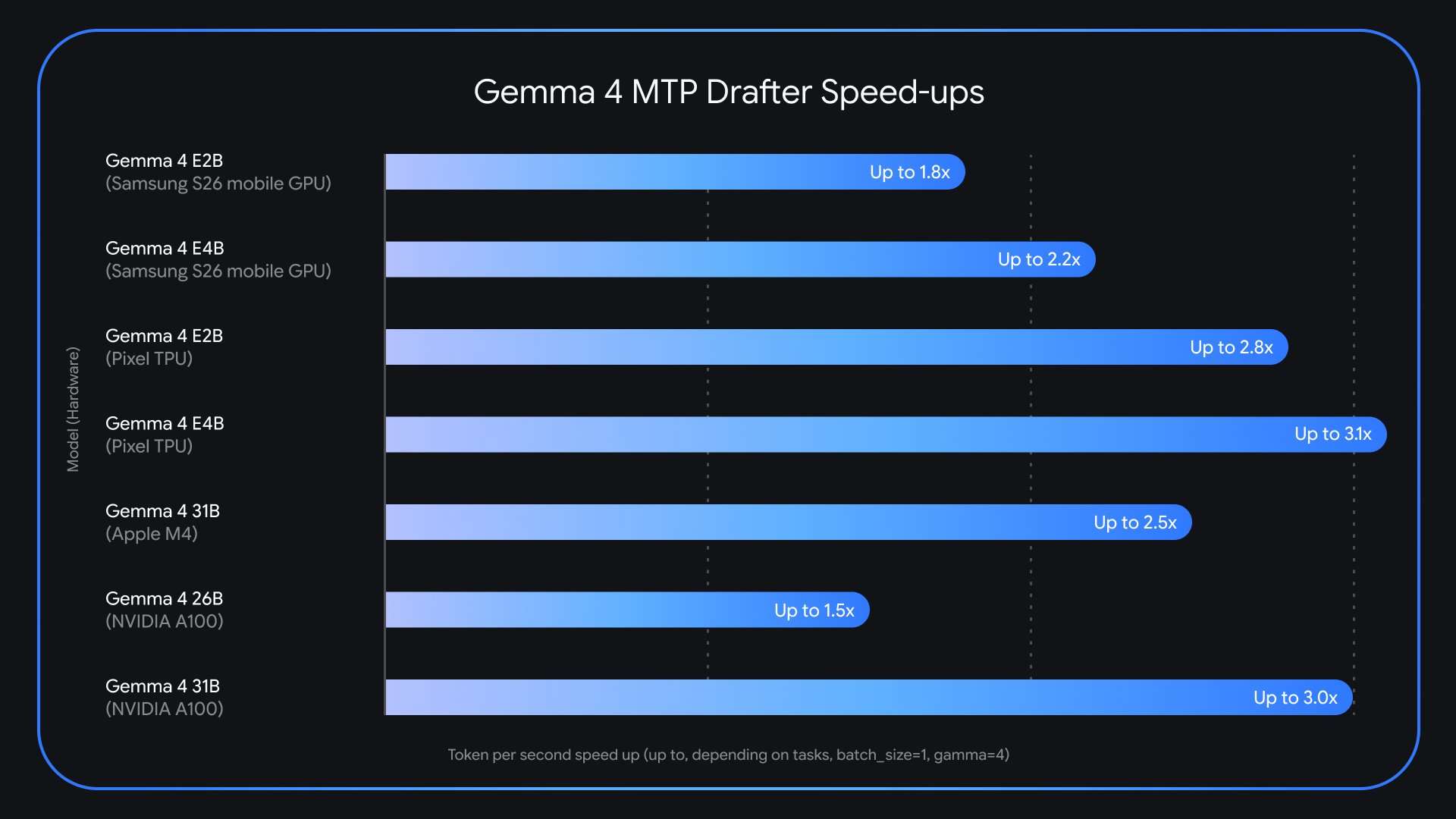
Google AI Releases Multi-Token Prediction (MTP) Drafters for Gemma 4: Delivering Up to 3x Faster Inference Without Quality Loss
MarkTechPost
Solidity LM surpasses Opus
Reddit r/LocalLLaMA

Quality comparison between Qwen 3.6 27B quantizations (BF16, Q8_0, Q6_K, Q5_K_XL, Q4_K_XL, IQ4_XS, IQ3_XXS,...)
Reddit r/LocalLLaMA


