
AVControl: Efficient Framework for Training Audio-Visual Controls
arXiv cs.CV / 3/27/2026
📰 NewsSignals & Early TrendsIdeas & Deep AnalysisModels & Research
Key Points
- AVControl introduces a lightweight, extendable framework for training audio-visual control of video generation using LTX-2, where each modality is learned as a separate LoRA without requiring architectural changes.
- The method uses a “parallel canvas” that injects the reference signal as additional tokens in attention layers, enabling structural control that fails when extending image in-context methods to video.
- Experiments on the VACE Benchmark show AVControl outperforms prior baselines for depth- and pose-guided generation tasks including inpainting and outpainting, with competitive results for camera control and audio-visual benchmarks.
- The framework supports many independently trained control modalities—spatial controls (depth/pose/edges), camera trajectories with intrinsics, sparse motion, video editing—and presents modular audio-visual controls for joint generation, reportedly among the first in this direction.
- The paper emphasizes efficiency, reporting that each modality can be trained with small datasets and converges in a few hundred to a few thousand steps, and it includes public code and trained LoRA checkpoints.
広告
Related Articles

Got My 39-Agent System Audited Live. Here's What the Maturity Scorecard Revealed.
Dev.to

The Redline Economy
Dev.to

$500 GPU outperforms Claude Sonnet on coding benchmarks
Dev.to

From Scattershot to Sniper: AI for Hyper-Personalized Media Lists
Dev.to
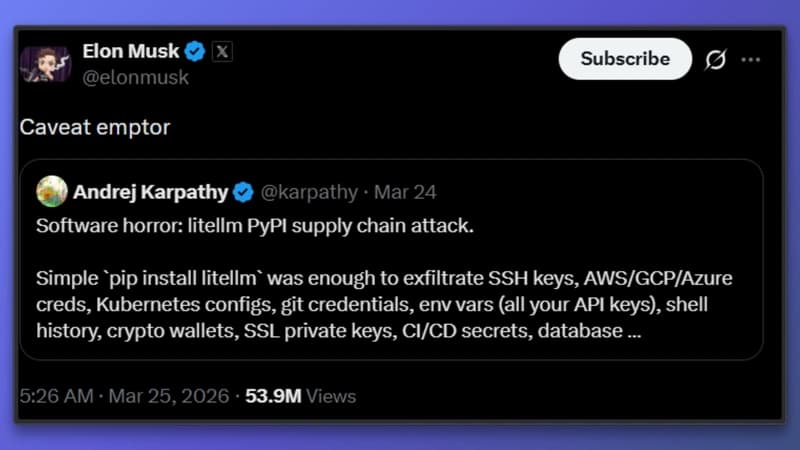
The LiteLLM Supply Chain Attack: A Wake-Up Call for AI Infrastructure
Dev.to


