
Unsupervised 4D Flow MRI Velocity Enhancement and Unwrapping Using Divergence-Free Neural Networks
arXiv cs.LG / 4/2/2026
💬 OpinionIdeas & Deep AnalysisModels & Research
Key Points
- The paper presents DAF-FlowNet, an unsupervised divergence- and aliasing-free neural network for 4D Flow MRI that simultaneously enhances noisy velocity fields and corrects phase-wrapping artifacts.
- DAF-FlowNet enforces mass conservation by parameterizing velocity as the curl of a vector potential, avoiding the need for manually tuned divergence-penalty terms.
- Using a cosine data-consistency loss, the method performs single-stage denoising and phase unwrapping from wrapped phase images.
- On synthetic CFD-generated aortic 4D Flow MRI, it reduces velocity and directional errors and significantly improves divergence metrics versus prior techniques across multiple noise levels.
- On both controlled unwrapping tests and 10 hypertrophic cardiomyopathy patient datasets, it shows strong robustness (including moderate segmentation perturbations) and improves internal flow consistency aligned with consensus-style mass-conservation analyses.
Related Articles
v5.5.0
Transformers(HuggingFace)Releases
Bonsai (PrismML's 1 bit version of Qwen3 8B 4B 1.7B) was not an aprils fools joke
Reddit r/LocalLLaMA

Big Tech firms are accelerating AI investments and integration, while regulators and companies focus on safety and responsible adoption.
Dev.to
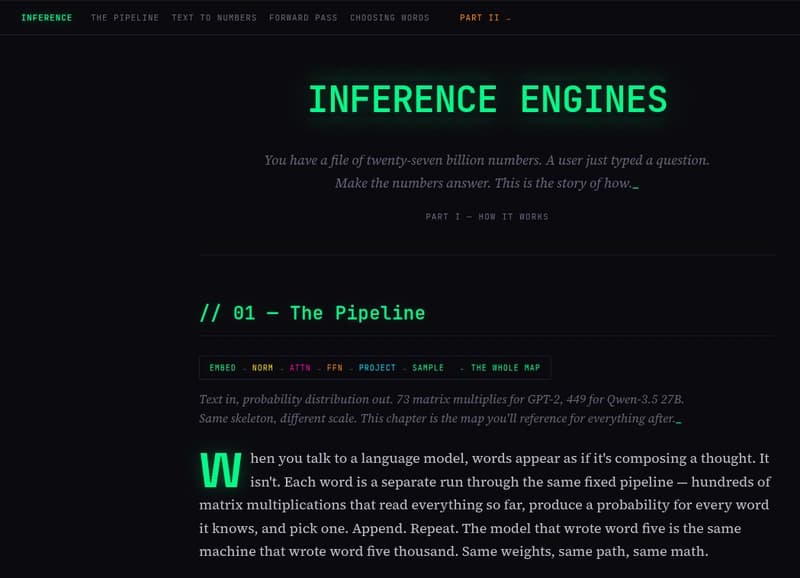
Inference Engines - A visual deep dive into the layers of an LLM
Dev.to
Surprised by how capable Qwen3.5 9B is in agentic flows (CodeMode)
Reddit r/LocalLLaMA


