
The Alignment Flywheel: A Governance-Centric Hybrid MAS for Architecture-Agnostic Safety
arXiv cs.RO / 4/30/2026
💬 OpinionDeveloper Stack & InfrastructureIdeas & Deep AnalysisModels & Research
Key Points
- The paper proposes an “Alignment Flywheel” multi-agent system (MAS) architecture that separates autonomous decision generation from safety governance to improve auditability.
- It introduces a stable “Safety Oracle” interface that returns raw safety signals, an enforcement layer that applies explicit risk policies at runtime, and a governance MAS that supervises the oracle via auditing and uncertainty-driven verification.
- A key engineering principle is “patch locality,” aiming to mitigate newly observed safety failures by updating the governed safety-oracle artifact and its release pipeline rather than retraining or retracting the underlying decision component.
- The architecture is designed to be implementation-agnostic for both the proposer and oracle, specifying roles, artifacts, protocols, and versioned release semantics for runtime gating and staged rollout across distributed deployments.
- Overall, it frames a framework for integrating powerful but fallible autonomous systems under explicit, version-controlled, and auditable oversight.
Related Articles
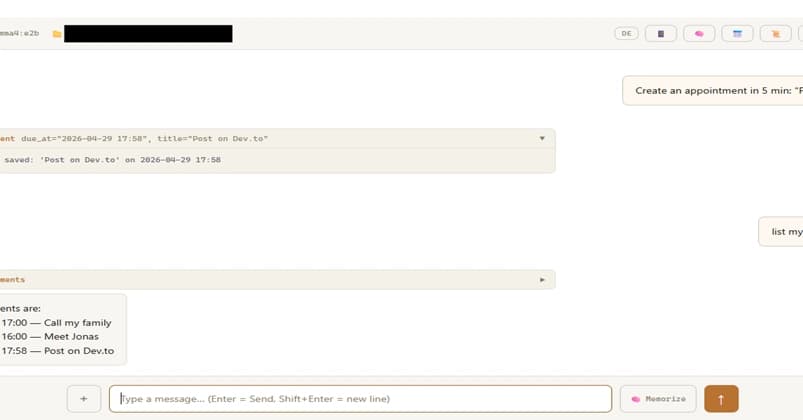
Building a Local AI Agent (Part 2): Six UX and UI Design Challenges
Dev.to
The Prompt Caching Mistake That's Costing You 70% More Than You Need to Pay
Dev.to
We Built a DNS-Based Discovery Protocol for AI Agents — Here's How It Works
Dev.to
Your first business opportunity in 3 commands: /register_directory in @biznode_bot, wait for matches, then /my_pulse to view...
Dev.to
Building AI Evaluation Pipelines: Automating LLM Testing from Dataset to CI/CD
Dev.to


