
Reliev3R: Relieving Feed-forward Reconstruction from Multi-View Geometric Annotations
arXiv cs.CV / 4/2/2026
📰 NewsIdeas & Deep AnalysisModels & Research
Key Points
- The paper introduces Reliev3R, a weakly-supervised training framework for feed-forward reconstruction models that reduces dependence on expensive multi-view geometric annotations like 3D point maps and camera poses.
- Instead of relying on costly structure-from-motion preprocessing, it leverages monocular relative depths and sparse image correspondences derived from zero-shot predictions from pretrained models to obtain 3D knowledge.
- Reliev3R proposes an ambiguity-aware relative depth loss and a trigonometry-based reprojection loss to enforce multi-view geometric consistency during training.
- Experiments claim that training from scratch with less data allows Reliev3R to reach performance comparable to fully-supervised FFRMs, aiming to make 3D reconstruction supervision more scalable and lower-cost.
Related Articles
v5.5.0
Transformers(HuggingFace)Releases
Bonsai (PrismML's 1 bit version of Qwen3 8B 4B 1.7B) was not an aprils fools joke
Reddit r/LocalLLaMA

Big Tech firms are accelerating AI investments and integration, while regulators and companies focus on safety and responsible adoption.
Dev.to
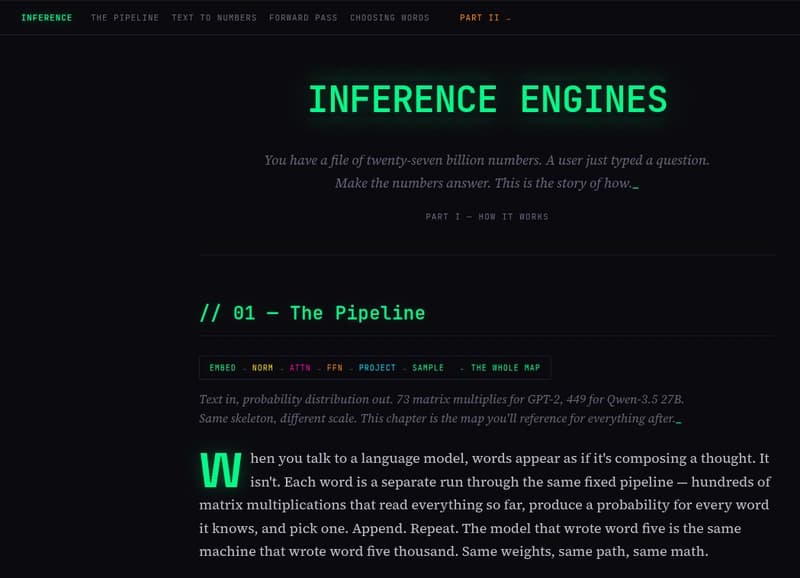
Inference Engines - A visual deep dive into the layers of an LLM
Dev.to
Surprised by how capable Qwen3.5 9B is in agentic flows (CodeMode)
Reddit r/LocalLLaMA


