
Global and Local Topology-Aware Attention with Persistent Homology and Euler Biases for Time-Series Forecasting
arXiv cs.LG / 5/6/2026
📰 NewsIdeas & Deep AnalysisModels & Research
Key Points
- The paper proposes a topology-aware attention framework for time-series forecasting that injects geometric and connectivity structure into attention logits using persistent homology (H0–H2), anchored Euler characteristic transforms, and kernel-Hilbert channels.
- It introduces validation-gated local residual mechanisms that apply local topological signals only when held-out validation data supports the correction, using exact Vietoris–Rips computations and smooth topological surrogates under a no-leakage evaluation protocol.
- Experiments across three architecture families (lightweight attention/Ridge, PatchTST, and a TimeSeriesTransformer) on synthetic benchmarks plus real datasets (CO2, S&P 500 return-window geometry, NASA IMS bearing degradation) show consistent positive paired effects when topology is predictive.
- Reported performance gains include mean relative RMSE reductions of about 12.5% (lightweight attention/Ridge), 23.5% (PatchTST), and 47.8% (TimeSeriesTransformer), with strong statistical significance from matched paired comparisons.
- Overall, the authors argue that topology can function as a validation-selected, architecture-compatible inductive bias for forecasting tasks where underlying geometry is informative.
Related Articles

Top 10 Free AI Tools for Students in 2026: The Ultimate Study Guide
Dev.to

AI as Your Contingency Co-Pilot: Automating Wedding Day 'What-Ifs'
Dev.to
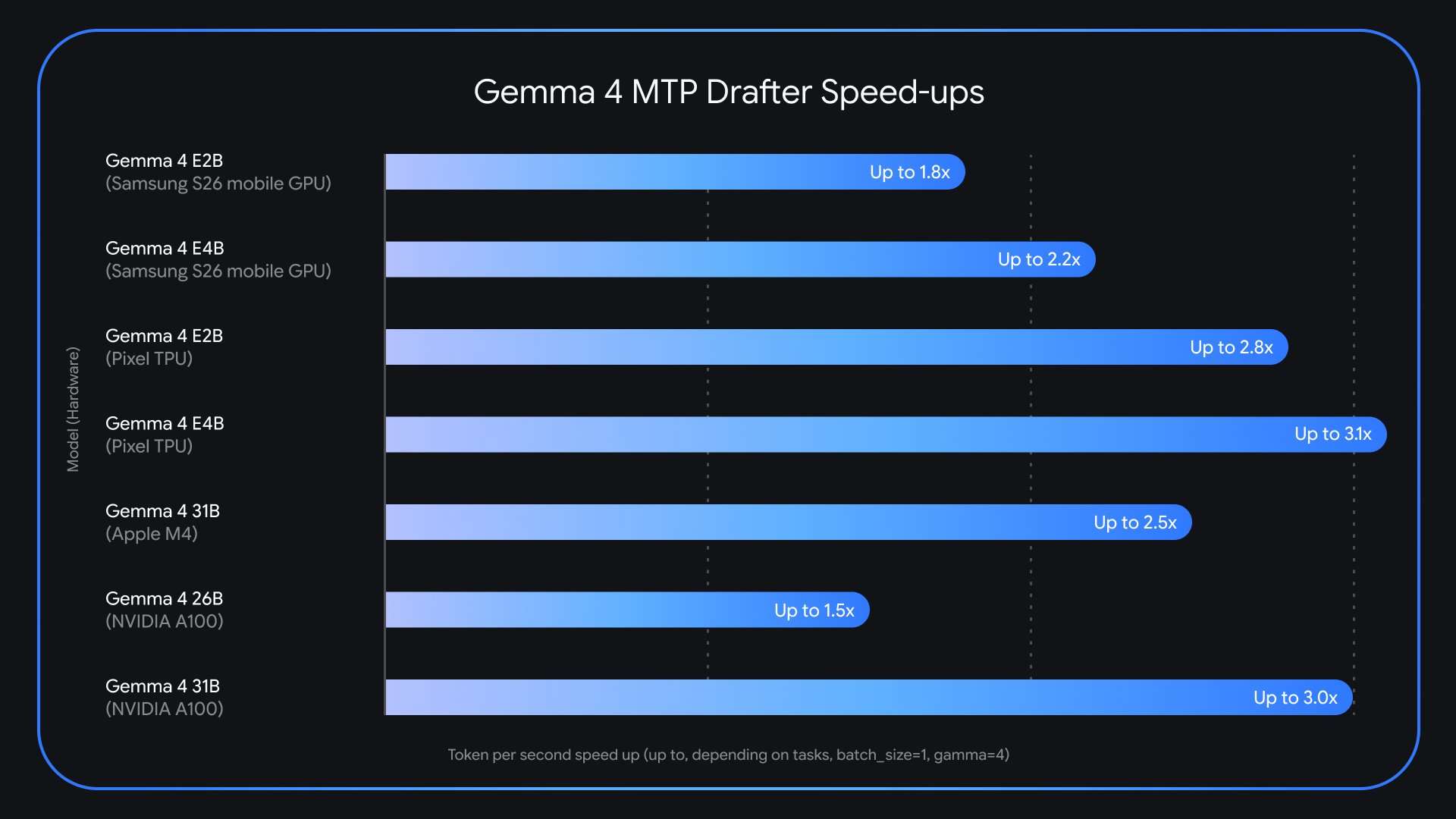
Google AI Releases Multi-Token Prediction (MTP) Drafters for Gemma 4: Delivering Up to 3x Faster Inference Without Quality Loss
MarkTechPost
When Claude Hallucinates in Court: The Latham & Watkins Incident and What It Means for Attorney Liability
MarkTechPost
Solidity LM surpasses Opus
Reddit r/LocalLLaMA


