
Adaptive Data Compression and Reconstruction for Memory-Bounded EEG Continual Learning
arXiv cs.LG / 5/6/2026
💬 OpinionIdeas & Deep AnalysisModels & Research
Key Points
- The paper introduces ADaCoRe, an unsupervised individual continual learning method for EEG that adapts to new subjects online while operating under strict memory limits.
- Unlike prior UICL approaches that store full past samples, ADaCoRe uses a morphology-aware pipeline combining saliency-driven keyframe protection, rational polyphase compression, and adjoint reconstruction to preserve important signal structure.
- The method includes adjoint reconstruction with verbatim overwrite for protected indices and prototype-confidence-based exemplar selection to maintain representative samples adaptively.
- Experiments on three benchmark datasets show ADaCoRe outperforms strong recent baselines in low-buffer regimes, with reported accuracy improvements of at least +2.7 on ISRUC and +15.3 on FACED.
- Ablation and visualization results quantify the compression–fidelity trade-offs and confirm that key EEG morphologies are retained after compression and reconstruction.
Related Articles

Top 10 Free AI Tools for Students in 2026: The Ultimate Study Guide
Dev.to

AI as Your Contingency Co-Pilot: Automating Wedding Day 'What-Ifs'
Dev.to
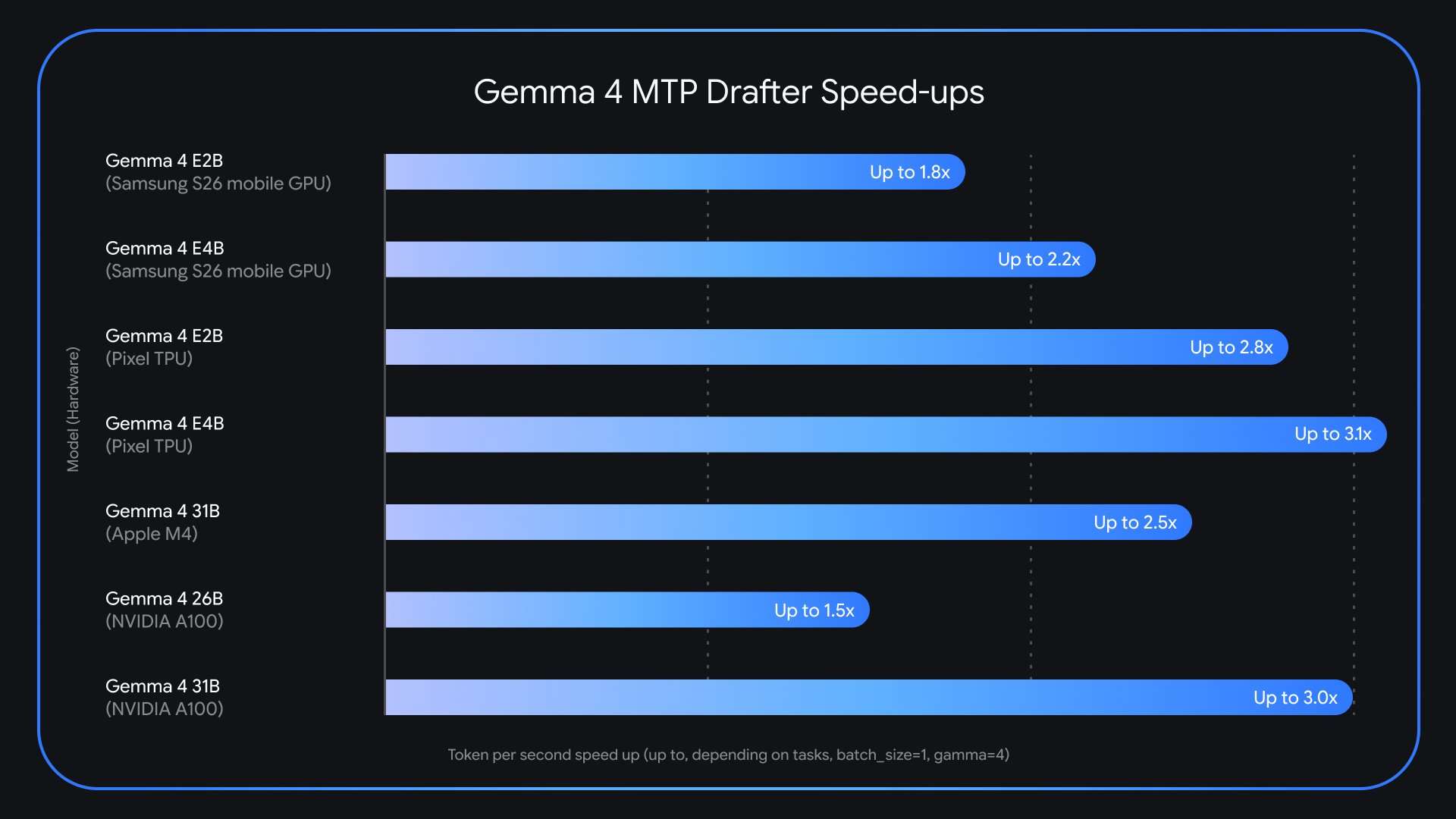
Google AI Releases Multi-Token Prediction (MTP) Drafters for Gemma 4: Delivering Up to 3x Faster Inference Without Quality Loss
MarkTechPost
When Claude Hallucinates in Court: The Latham & Watkins Incident and What It Means for Attorney Liability
MarkTechPost
Solidity LM surpasses Opus
Reddit r/LocalLLaMA


