
A Player Selection Network for Scalable Game-Theoretic Prediction and Planning
arXiv cs.RO / 4/2/2026
💬 OpinionIdeas & Deep AnalysisModels & Research
Key Points
- The paper introduces PSN Game, a learning-based game-theoretic prediction and planning framework that reduces multi-agent planning complexity by learning a Player Selection Network (PSN) to mask out less influential agents.
- A Player Selection Network outputs a selection mask so the ego agent solves a smaller optimization problem over only the chosen players, yielding faster computation times for scalable, real-time settings.
- To handle incomplete-information scenarios where other agents’ intentions are unknown, the authors add a Goal Inference Network (GIN) that enables PSN to work without test-time fine-tuning.
- Experiments on simulated scenarios and real-world pedestrian trajectory datasets show PSN is competitive with, and often improves, baseline game-theoretic selection methods in both prediction accuracy and planning safety.
- The method typically selects far fewer players than exist in the full game, demonstrating that it can generalize across conditions while integrating into existing multi-agent planning pipelines.
Related Articles
v5.5.0
Transformers(HuggingFace)Releases
Bonsai (PrismML's 1 bit version of Qwen3 8B 4B 1.7B) was not an aprils fools joke
Reddit r/LocalLLaMA

Big Tech firms are accelerating AI investments and integration, while regulators and companies focus on safety and responsible adoption.
Dev.to
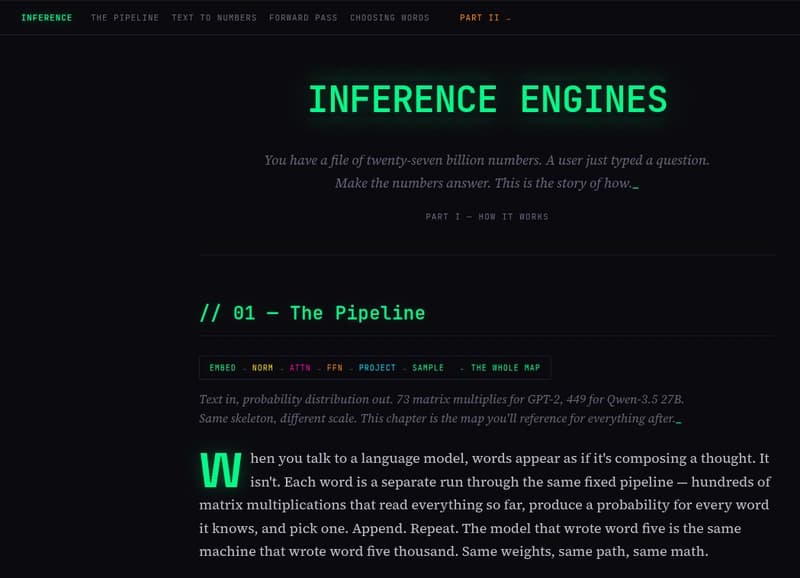
Inference Engines - A visual deep dive into the layers of an LLM
Dev.to
Surprised by how capable Qwen3.5 9B is in agentic flows (CodeMode)
Reddit r/LocalLLaMA


