
Adaptive Forensic Feature Refinement via Intrinsic Importance Perception
arXiv cs.CV / 4/21/2026
📰 NewsModels & Research
Key Points
- The paper targets synthetic image detection (SID), focusing on cross-distribution generalization when images come from previously unseen generative sources.
- While visual foundation models (VFM) can improve SID via image–text pretraining priors, existing adaptation methods are described as too coarse and may either ignore the best representation level or risk degrading open-set generalization.
- The authors reformulate VFM adaptation as a joint optimization that (1) finds the most forgery-discriminative representational layer and (2) limits how much task learning perturbs the pretrained cross-modal structure.
- They propose I2P (Intrinsic Importance Perception), which adaptively selects critical layer representations and performs task-driven updates within a low-sensitivity parameter subspace to boost task specificity while preserving transferability.
- Overall, the contribution is a more fine-grained, structure-preserving adaptation strategy for VFM-based SID to better handle unknown generation sources.
Related Articles
No Free Lunch Theorem — Deep Dive + Problem: Reverse Bits
Dev.to

Salesforce Headless 360: Run Your CRM Without a Browser
Dev.to
RAG Systems in Production: Building Enterprise Knowledge Search
Dev.to
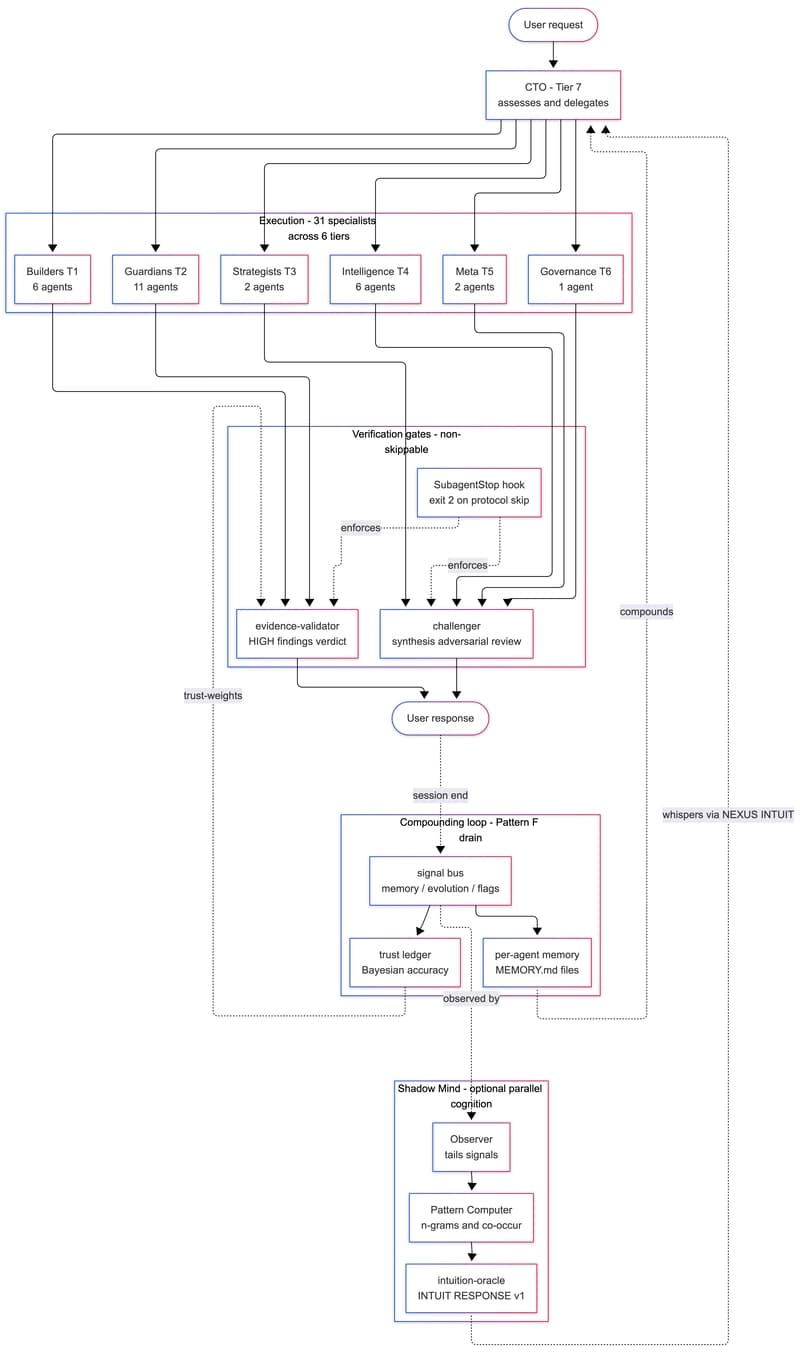
We Built a 31-Agent AI Team That Hires Itself, Critiques Itself, and Dreams
Dev.to
gpt-image-2 API: ship 2K AI images in Next.js for $0.21 (2026)
Dev.to


