AI bats away ping-pong challenge as rise of the machines continues
Sony project claims a significant breakthrough with applications in task requiring speed and accuracy


Rise of the Machines The ancient games of chess and Go are now mere staging posts in the journey toward robots demonstrating their superior performance to humans - the machines can now beat us fleshbags at ping-pong.

Capering about with a small bat smacking a tiny air-filled plastic ball to-and-fro across a six-inch net requires a bit of athletic skill, but table tennis fans can't bank on being able to beat the machine anymore.
A paper in Nature this week shows an AI-based robotic system can outperform elite table tennis players. Developed by Sony AI, the system it calls Ace shows the capacity for robots and AI to achieve complex, real-time interactive tasks which might have broader applications.
"The system can not only challenge professional players, but also provide valuable insights on human strategy and movement," according to an accompanying article describing the work.
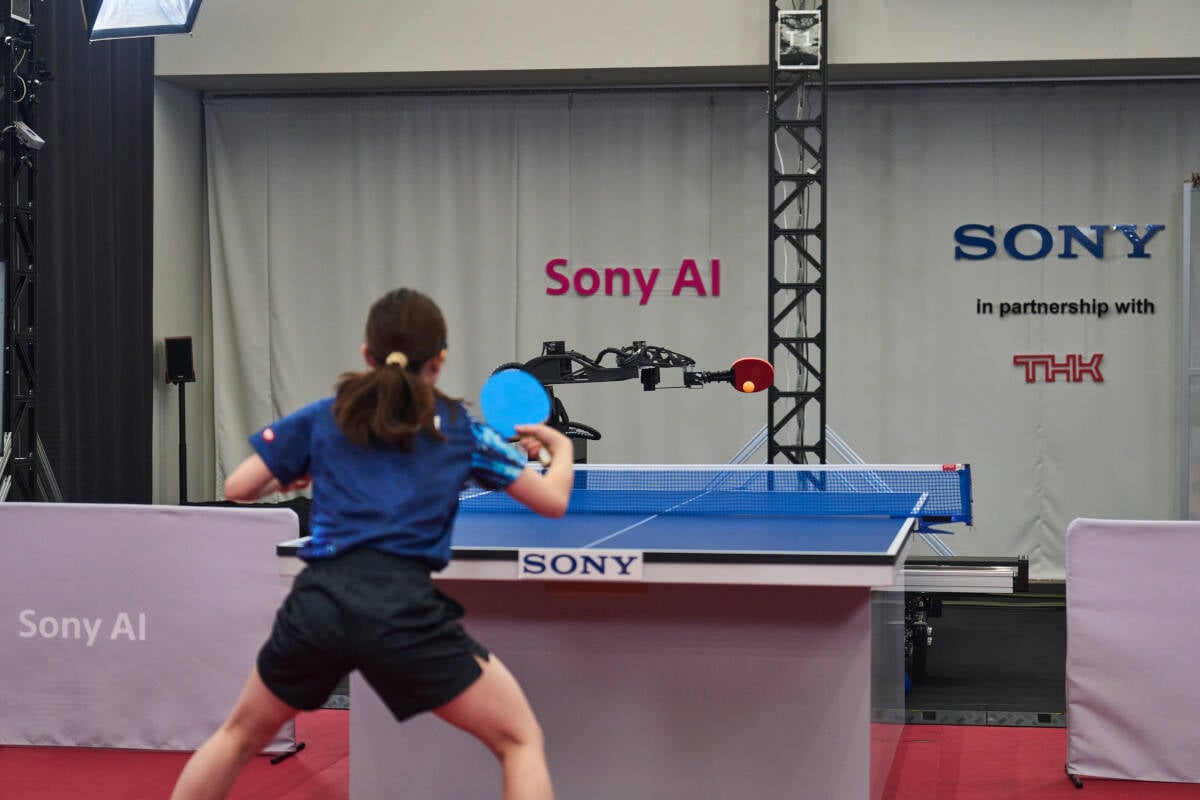
Ace fires a shot back to its human opponent, Minami Ando, during a match in April 2025 – Pic credit: Sony AI
During amateur play, a table tennis ball might travel at about 96kph (60 miles per hour) across the table. With professional players, that can rise to as high as 150 kph (93 mph) during a smash. When players apply spin, it changes the ball's trajectory as the Magnus effect distributes airflow asymmetrically over the ball, and also as it bounces off the table.
The AI and engineering professors based in Brazil point out that designing and building a system able to play such a fast-moving sport requires engineers to design-in features which can detect an environmental change, decide how to react and then implement that reaction at speeds that enable them to compete with humans. The challenge cuts across many fields of engineering, they said.
- Bots, bias, and bunk: How can you tell what's real on the net?
- AI scores a huge own goal if you play up and play the game
- Go No! Google cyber-brain bests top-ranked human in ancient game
- AI shoves all in: DeepStack, Libratus poker bots battle Texas Hold 'em pros heads up
Ace is built from three modules, including a high-speed perception system, a control system and a robotic arm. "The perception system used conventional cameras to locate the ball and three 'gaze control systems' that estimated the rate at which it was spinning, known as its angular velocity. The direction and rate of a table-tennis ball's spin determines its trajectory — a skilled player can give the ball a desired spin to deliver shots that are difficult for their opponent to return," the accompanying news article explained.
The work was led by Peter Dürr, director of Sony AI in Zürich. Also involved was his colleague Peter Stone, chief scientist at Sony AI, who said the research represented "a landmark moment in AI research." It demonstrated that an AI system can perceive, reason, and act effectively in complex, rapidly changing real-world environments that demand precision and speed.
"Once AI can operate at an expert human level under these conditions, it opens the door to an entirely new class of real-world applications that were previously out of reach," Stone said. ®