
AHPA: Adaptive Hierarchical Prior Alignment for Diffusion Transformers
arXiv cs.CV / 5/6/2026
📰 NewsModels & Research
Key Points
- The paper argues that current representation alignment for Diffusion Transformers often uses fixed supervision targets or fixed alignment granularity across all denoising timesteps, which is suboptimal.
- It claims that the appropriate alignment granularity should vary with the signal-to-noise ratio: coarse semantic/layout anchoring works better at high-noise steps, while low-noise steps benefit from spatially detailed, structurally faithful refinement.
- To fix the resulting representational mismatch, the authors propose Adaptive Hierarchical Prior Alignment (AHPA), which leverages multi-level hierarchical features from a frozen VAE encoder instead of relying on a single compressed latent target.
- A timestep-conditioned Dynamic Router adaptively selects and weights these hierarchical priors along the denoising trajectory, aligning supervision granularity with changing training needs.
- Experiments indicate AHPA improves convergence and generation quality versus baselines, adds no inference-time cost, and avoids external encoder supervision during training.
Related Articles
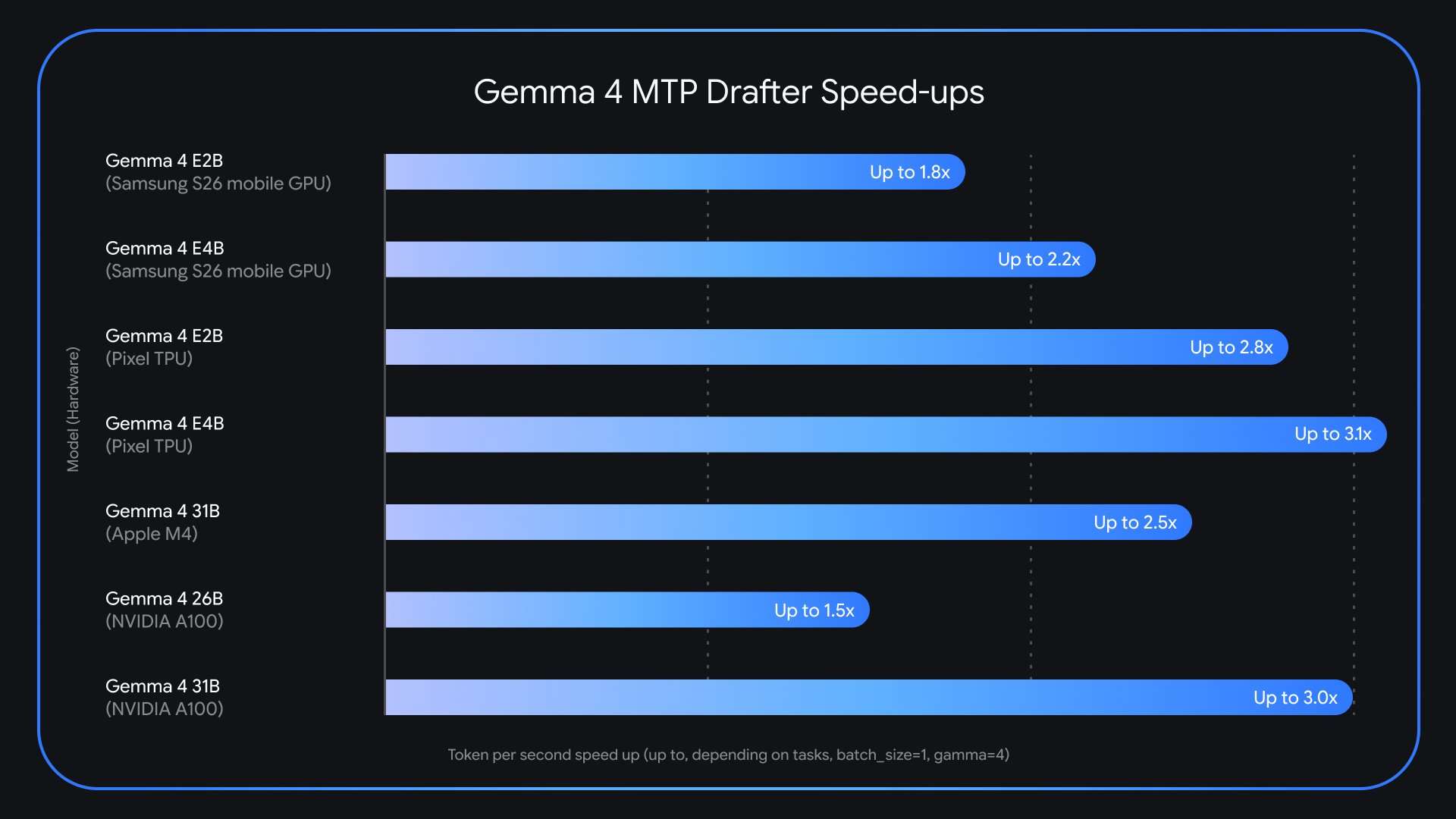
Google AI Releases Multi-Token Prediction (MTP) Drafters for Gemma 4: Delivering Up to 3x Faster Inference Without Quality Loss
MarkTechPost
Solidity LM surpasses Opus
Reddit r/LocalLLaMA

Quality comparison between Qwen 3.6 27B quantizations (BF16, Q8_0, Q6_K, Q5_K_XL, Q4_K_XL, IQ4_XS, IQ3_XXS,...)
Reddit r/LocalLLaMA

We measured the real cost of running a GPT-5.4 chatbot on live websites
Reddit r/artificial

AI ecosystems in China and US grow apart amid tech war
SCMP Tech


