
Universal YOCO for Efficient Depth Scaling
arXiv cs.CL / 4/3/2026
📰 NewsSignals & Early TrendsIdeas & Deep AnalysisModels & Research
Key Points
- The paper argues that while test-time scaling improves LLM reasoning, conventional Transformer inference strategies do not scale compute efficiently due to looping overhead and KV-cache growth with depth.
- It introduces Universal YOCO (YOCO-U), combining the YOCO decoder-decoder architecture with recursive computation to improve the capability-efficiency tradeoff beyond either approach alone.
- YOCO-U uses a Universal Self-Decoder that runs multiple iterations via parameter sharing, while restricting iterations to shallow, efficient-attention layers to control overhead.
- The approach aims to keep a constant global KV cache and provide linear pre-filling, using partial recursion to increase representational depth with limited additional cost.
- Experiments reportedly show YOCO-U remains competitive on general and long-context benchmarks, indicating that integrating efficient-attention designs with recursion is a promising path for scalable LLM inference.
Related Articles

Black Hat Asia
AI Business

90000 Tech Workers Got Fired This Year and Everyone Is Blaming AI but Thats Not the Whole Story
Dev.to

Microsoft’s $10 Billion Japan Bet Shows the Next AI Battleground Is National Infrastructure
Dev.to
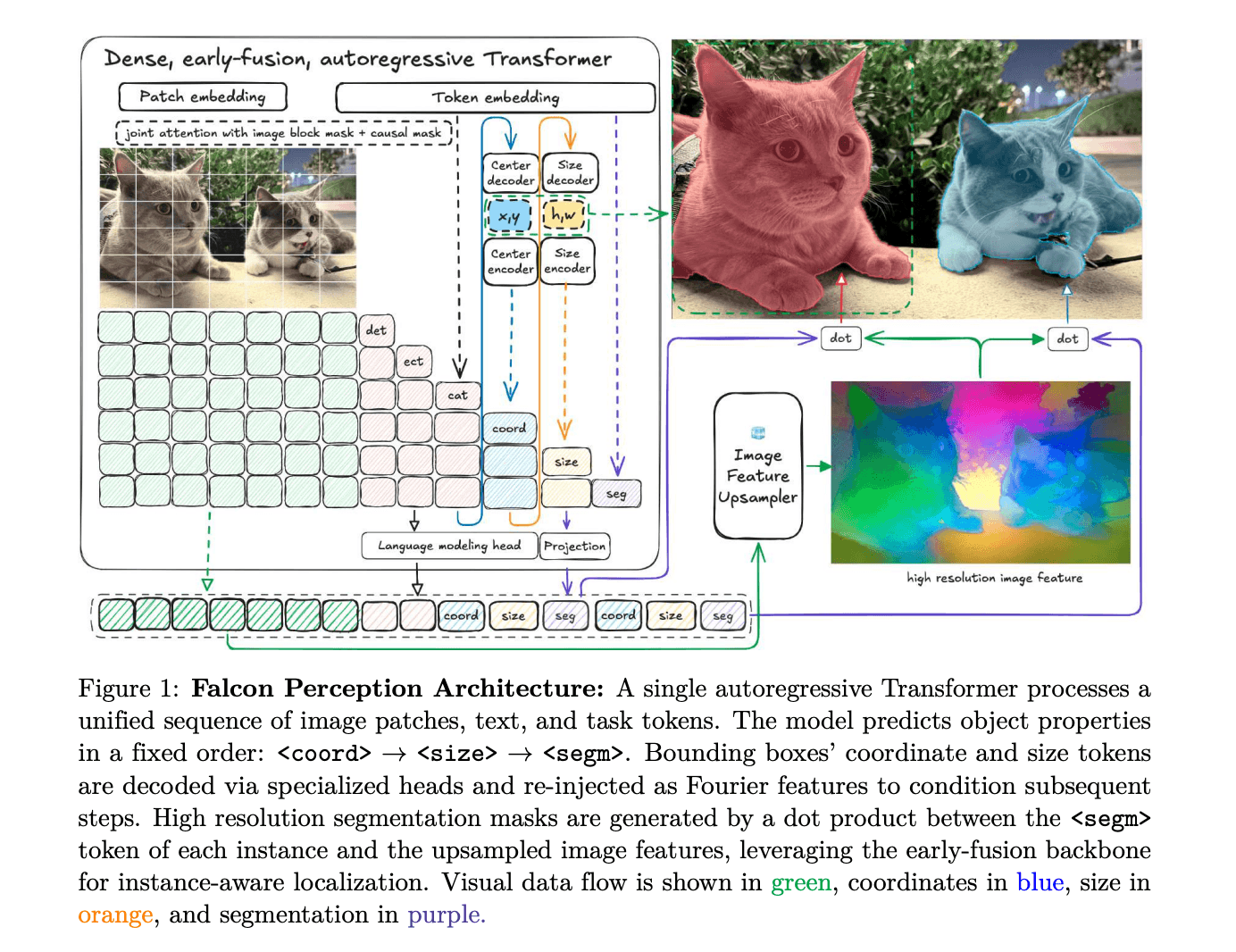
TII Releases Falcon Perception: A 0.6B-Parameter Early-Fusion Transformer for Open-Vocabulary Grounding and Segmentation from Natural Language Prompts
MarkTechPost

Portable eye scanner powered by AI expands access to low-cost community screening
Reddit r/artificial


