
Phase space integrity in neural network models of Hamiltonian dynamics: A Lagrangian descriptor approach
arXiv cs.LG / 4/2/2026
💬 OpinionSignals & Early TrendsIdeas & Deep AnalysisModels & Research
Key Points
- The paper proposes Lagrangian Descriptors (LDs) as a diagnostic framework to evaluate neural network models of Hamiltonian dynamics using geometric/structural information (e.g., orbits and separatrices) rather than only short-term trajectory accuracy.
- It embeds LD-derived geometric information into probability density functions weighted by LD values, enabling information-theoretic comparison between learned models and reference dynamics.
- Benchmarks compare physically constrained symplectic/energy-respecting architectures (SympNet, HénonNet, generalized Hamiltonian neural networks) against data-driven reservoir computing on canonical systems.
- On the Duffing oscillator, all approaches recover homoclinic orbit geometry with modest data, but accuracy near critical structures differs across model families.
- On the nonlinear three-mode Schrödinger equation, symplectic architectures preserve energy yet can distort phase-space topology, while reservoir computing reproduces homoclinic structure with high fidelity, highlighting LD-based diagnostics for “global dynamical integrity.”
Related Articles

Black Hat Asia
AI Business
v5.5.0
Transformers(HuggingFace)Releases
Bonsai (PrismML's 1 bit version of Qwen3 8B 4B 1.7B) was not an aprils fools joke
Reddit r/LocalLLaMA
Big Tech firms are accelerating AI investments and integration, while regulators and companies focus on safety and responsible adoption.
Dev.to
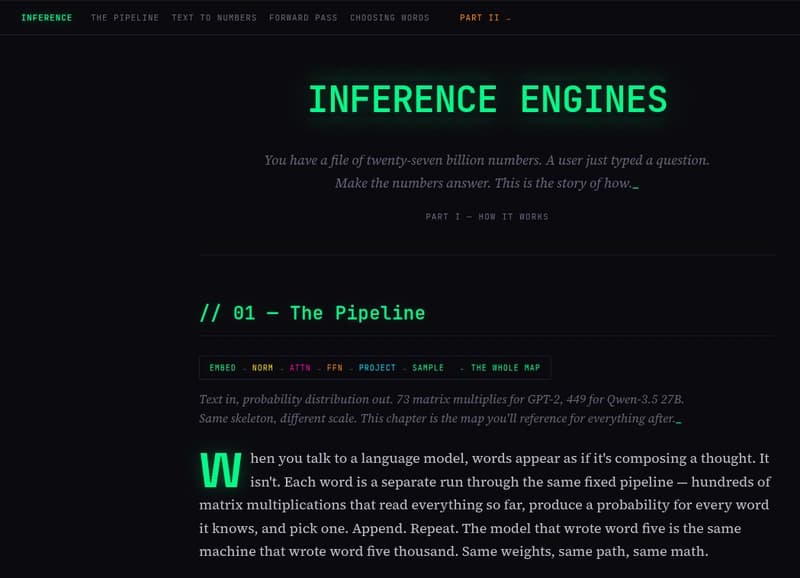
Inference Engines - A visual deep dive into the layers of an LLM
Dev.to


