
Reconsidering Dependency Networks from an Information Geometry Perspective
arXiv cs.LG / 4/2/2026
💬 OpinionSignals & Early TrendsIdeas & Deep AnalysisModels & Research
Key Points
- The paper addresses a gap in the theoretical foundations of dependency networks by analyzing pseudo-Gibbs sampling using information geometry.
- It interprets each pseudo-Gibbs sampling step as an m-projection onto a full conditional manifold and introduces the full conditional divergence to study how the stationary distribution is positioned.
- The authors derive an upper bound characterizing the stationary distribution’s location in probability space and reformulate both structure and parameter learning as optimization problems.
- Structure and parameter learning are shown to decompose into independent per-node subproblems, making the learning formulation more tractable.
- The paper proves that the learned model distribution converges to the true underlying distribution as training data size goes to infinity, with experiments indicating the bound is tight in practice.
Related Articles

Black Hat Asia
AI Business
v5.5.0
Transformers(HuggingFace)Releases
Bonsai (PrismML's 1 bit version of Qwen3 8B 4B 1.7B) was not an aprils fools joke
Reddit r/LocalLLaMA

Big Tech firms are accelerating AI investments and integration, while regulators and companies focus on safety and responsible adoption.
Dev.to
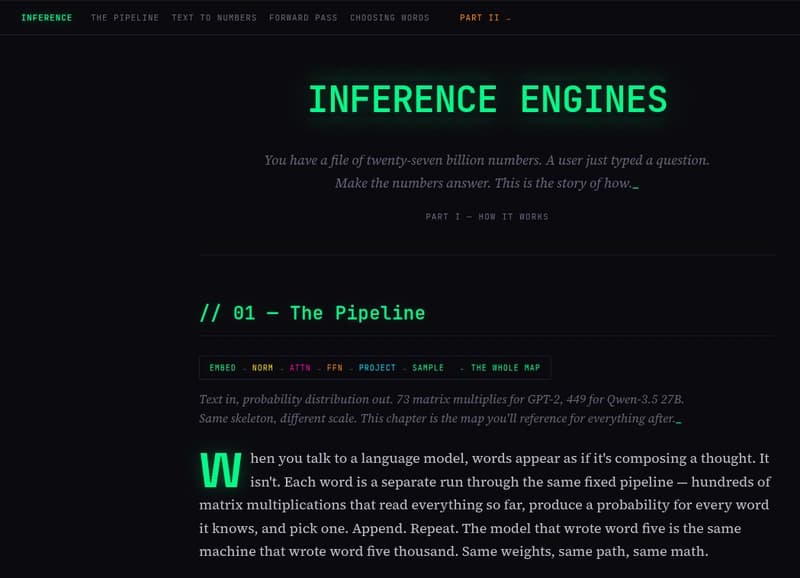
Inference Engines - A visual deep dive into the layers of an LLM
Dev.to


