
Algebraic Diversity: Group-Theoretic Spectral Estimation from Single Observations
arXiv cs.LG / 4/7/2026
💬 OpinionSignals & Early TrendsIdeas & Deep AnalysisModels & Research
Key Points
- The paper introduces a “General Replacement Theorem” showing that temporal averaging across multiple observations can be replaced by applying an algebraic group action to a single observation for second-order (covariance/subspace) estimation.
- It proves an “Optimality Theorem” that the symmetric group is universally optimal, recovering the KL transform in the proposed framework, and provides a polynomial-time method via a closed-form double-commutator eigenvalue problem to select the optimal group.
- The framework unifies the DFT, DCT, and KLT as group-matched spectral transforms, positioning group choice as the mechanism behind classical spectral transforms.
- The work demonstrates multiple applications that avoid multi-snapshot processing, including single-snapshot MUSIC DOA, massive MIMO channel estimation with reported 64% throughput gain, and single-pulse waveform classification at 90% accuracy.
- It also presents an analysis targeting transformer LLMs, reporting that RoPE “uses the wrong algebraic group” for 70–80% of attention heads across five models, and that content-dependent group choice plus spectral-concentration-based pruning can improve perplexity at the 13B scale without training or gradients.
Related Articles

Black Hat Asia
AI Business
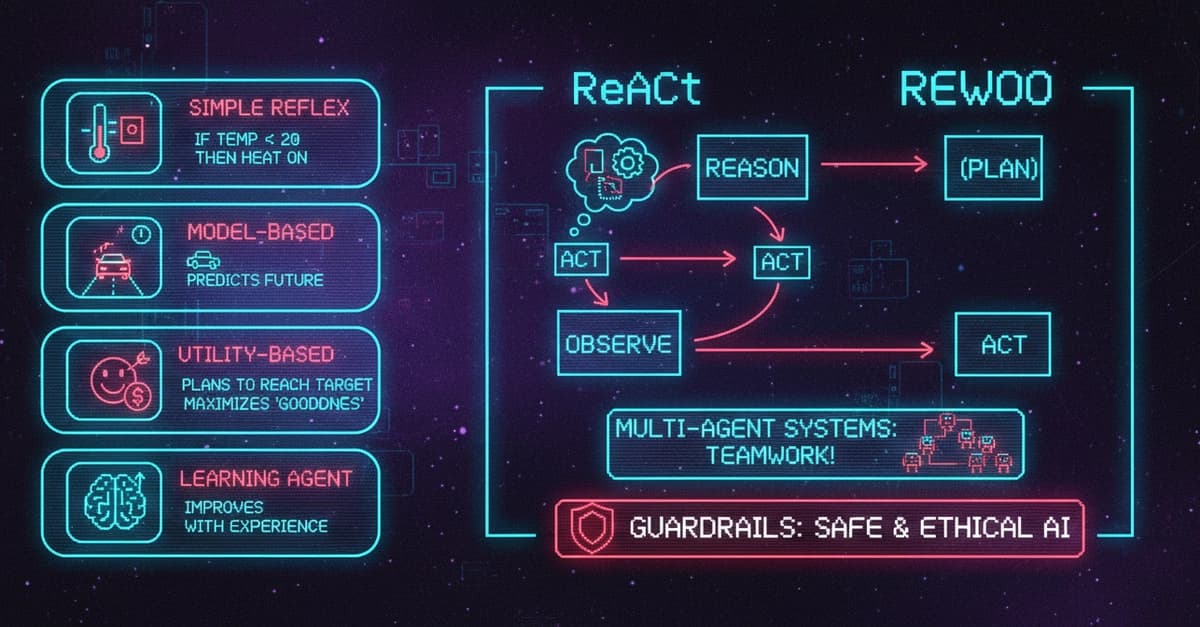
AI Agents Explained: 5 Types, Components, Frameworks, and Real-World Use Cases
Dev.to

Edge-to-Cloud Swarm Coordination for circular manufacturing supply chains with embodied agent feedback loops
Dev.to
Why QIS Is Not a Sync Problem: The Mailbox Model for Distributed Intelligence
Dev.to

The Ethics of AI: A Developer's Responsibility
Dev.to


