
Label-efficient underwater species classification with semi-supervised learning on frozen foundation model embeddings
arXiv cs.CV / 4/2/2026
💬 OpinionSignals & Early TrendsIdeas & Deep AnalysisModels & Research
Key Points
- The paper proposes a label-efficient semi-supervised underwater species classifier by running self-training on frozen DINOv3 ViT-B foundation model embeddings, avoiding any embedding fine-tuning.
- With fewer than 5% of the available labels, the method largely closes the performance gap versus a fully supervised ConvNeXt model trained on all labeled data, and at full label availability it narrows to only a few percentage points.
- Evaluation on the AQUA20 marine species benchmark shows strong class separability in the frozen embedding space (high ROC-AUC), suggesting discriminative structure is present even when decision boundaries are not yet well estimated.
- The approach claims practical deployment benefits because it requires no training, no domain-specific data engineering, and no underwater-adapted models, and results are averaged over 100 random seed initializations.
- The core contribution is demonstrating that semi-supervised learning atop pretrained, frozen representations can reduce expert annotation costs and improve transfer across new underwater conditions.
Related Articles

Black Hat Asia
AI Business
v5.5.0
Transformers(HuggingFace)Releases
Bonsai (PrismML's 1 bit version of Qwen3 8B 4B 1.7B) was not an aprils fools joke
Reddit r/LocalLLaMA

Big Tech firms are accelerating AI investments and integration, while regulators and companies focus on safety and responsible adoption.
Dev.to
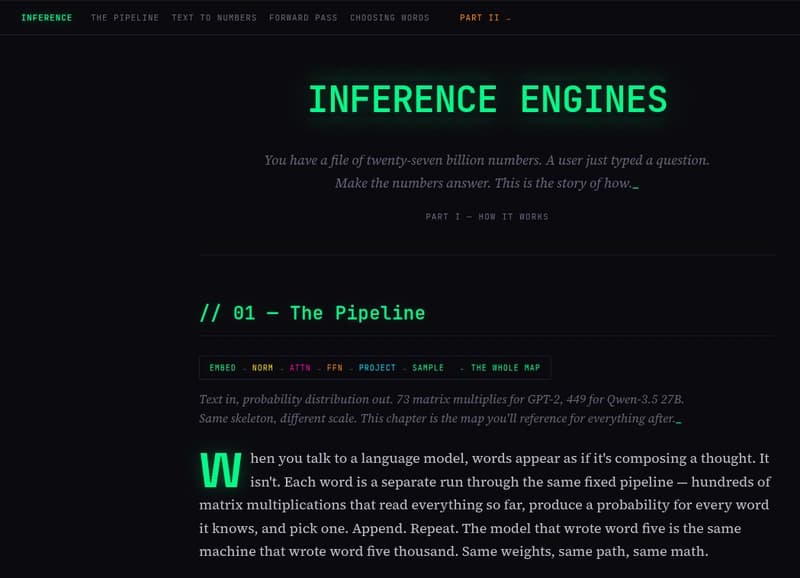
Inference Engines - A visual deep dive into the layers of an LLM
Dev.to


