
RawGen: Learning Camera Raw Image Generation
arXiv cs.CV / 4/2/2026
📰 NewsSignals & Early TrendsIdeas & Deep AnalysisModels & Research
Key Points
- The paper introduces RawGen, a diffusion-based framework for generating camera raw (linear, scene-referred) images from text and for inverting sRGB back to camera-specific raw representations.
- RawGen is motivated by the difficulty of collecting large-scale raw datasets, since existing raw datasets are limited and often tied to specific camera hardware and fixed image signal processor (ISP) pipelines.
- To produce physically meaningful linear outputs rather than photo-finished sRGB, the method uses specialized processing across latent and pixel spaces and trains on a many-to-one inverse-ISP dataset that anchors multiple ISP-varied sRGB renditions to a common scene target.
- The authors fine-tune a conditional denoiser and a specialized decoder to better handle unknown and diverse ISP pipelines, improving camera-centric linear reconstructions compared with traditional inverse-ISP approaches.
- They also report that RawGen can generate scalable, text-driven synthetic raw data that helps downstream low-level vision tasks beyond raw reconstruction itself.
Related Articles

Black Hat Asia
AI Business
v5.5.0
Transformers(HuggingFace)Releases
Bonsai (PrismML's 1 bit version of Qwen3 8B 4B 1.7B) was not an aprils fools joke
Reddit r/LocalLLaMA

Big Tech firms are accelerating AI investments and integration, while regulators and companies focus on safety and responsible adoption.
Dev.to
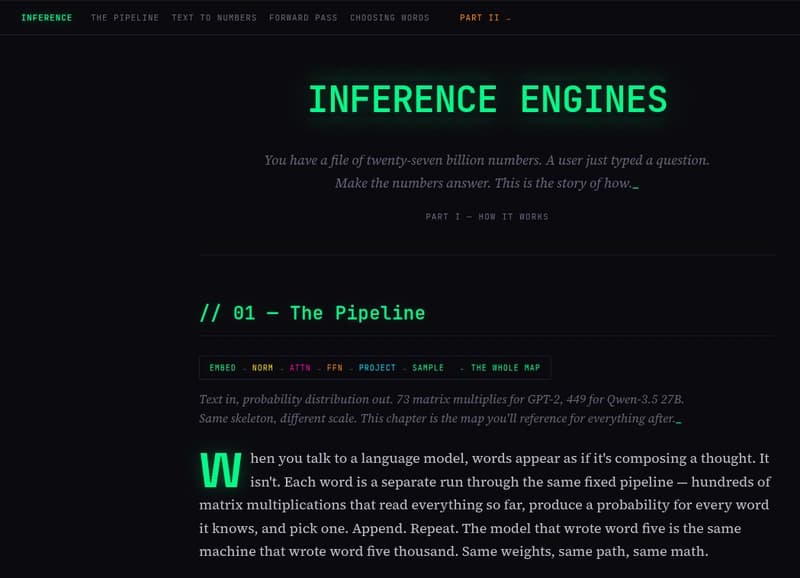
Inference Engines - A visual deep dive into the layers of an LLM
Dev.to


