
Characterizing Model-Native Skills
arXiv cs.AI / 4/21/2026
📰 NewsIdeas & Deep AnalysisTools & Practical UsageModels & Research
Key Points
- The paper argues that “skill” characterization for language models should be model-native, meaning it is derived from the model’s internal representations rather than from human-written taxonomies or manual profiling pipelines.
- It proposes recovering a compact orthogonal basis from sequence-level activations, producing semantically interpretable but ontology-agnostic axes that capture behavioral variation the model organizes internally.
- Using this basis, the authors perform both SFT data selection and inference-time steering, showing large gains in reasoning benchmarks (e.g., up to 20% Pass@1 on MATH and up to 41% on AMC) compared with selection based on human-characterized skills.
- They also develop lightweight proxy interventions to identify the most useful directions for a given model and demonstrate additional improvements via steering vectors at inference time (e.g., up to 4.8% Pass@8 on MATH).
- Beyond reasoning, the approach improves safety alignment by selecting adversarial training data for model-native skill coverage instead of relying on textual diversity, with better sample efficiency; the code is open-sourced.
Related Articles

Black Hat USA
AI Business

¿Hasta qué punto podría la IA reemplazarnos en nuestros trabajos? A veces creo que la gente exagera un poco.
Reddit r/artificial
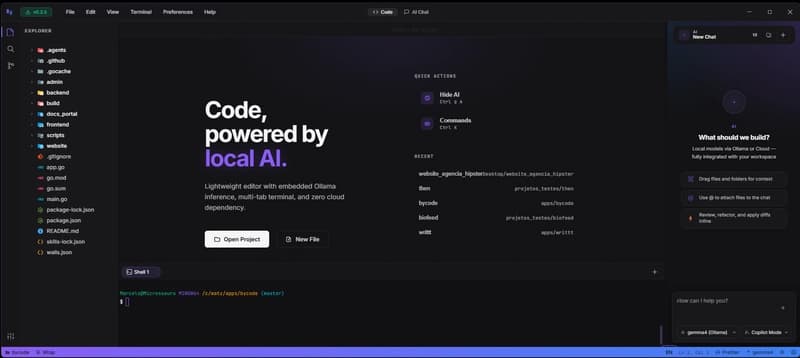
Why I Built byCode: A 100% Local, Privacy-First AI IDE
Dev.to

Magnificent irony as Meta staff unhappy about running surveillance software on work PCs
The Register
v0.21.1
Ollama Releases


