
Inverse-Free Sparse Variational Gaussian Processes
arXiv stat.ML / 4/2/2026
📰 NewsIdeas & Deep AnalysisModels & Research
Key Points
- The paper addresses the scalability bottleneck of sparse variational Gaussian processes by avoiding Cholesky-based computations that are poorly matched to low-precision, massively parallel hardware.
- It proposes an improved, better-conditioned inverse-free variational bound and derives a matmul-only natural-gradient update rule for the auxiliary parameter to improve stability and convergence.
- The authors add practical heuristics (e.g., step-size schedules and stopping criteria) so the optimisation routine can be integrated into existing SVGP workflows.
- Experiments on regression and classification benchmarks show the method can act as a drop-in replacement for SVGP-based models (including deep GPs), achieving comparable performance and sometimes faster runtimes when tuned.
Related Articles
v5.5.0
Transformers(HuggingFace)Releases
Bonsai (PrismML's 1 bit version of Qwen3 8B 4B 1.7B) was not an aprils fools joke
Reddit r/LocalLLaMA

Big Tech firms are accelerating AI investments and integration, while regulators and companies focus on safety and responsible adoption.
Dev.to
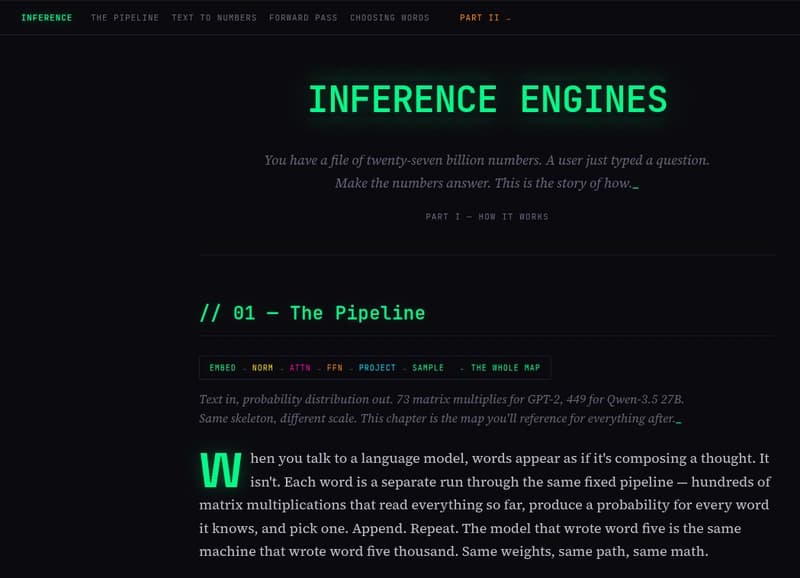
Inference Engines - A visual deep dive into the layers of an LLM
Dev.to
Surprised by how capable Qwen3.5 9B is in agentic flows (CodeMode)
Reddit r/LocalLLaMA


