
Embedded Variational Neural Stochastic Differential Equations for Learning Heterogeneous Dynamics
arXiv cs.LG / 4/2/2026
💬 OpinionIdeas & Deep AnalysisModels & Research
Key Points
- The paper proposes a Variational Neural Stochastic Differential Equation (V-NSDE) framework to model socioeconomic time-series data with both trends and stochastic fluctuations across multiple districts.
- It combines a VAE-style encoder/decoder with a Neural SDE latent dynamics core, where an encoder produces an initial latent Gaussian distribution conditioned on district embeddings and observations.
- The Neural SDE learns continuous-time drift and diffusion functions using neural networks that take time, latent state, and district embeddings as inputs, enabling heterogeneous dynamics per district.
- Observations are reconstructed through a probabilistic decoder that outputs Gaussian likelihood parameters at each time step, trained via ELBO with an added KL-divergence regularization term.
- Experimental results (on Odisha district data) indicate improved ability to capture complex temporal patterns and generate realistic trajectories showing both clear trends and random variations.
Related Articles
v5.5.0
Transformers(HuggingFace)Releases
Bonsai (PrismML's 1 bit version of Qwen3 8B 4B 1.7B) was not an aprils fools joke
Reddit r/LocalLLaMA

Big Tech firms are accelerating AI investments and integration, while regulators and companies focus on safety and responsible adoption.
Dev.to
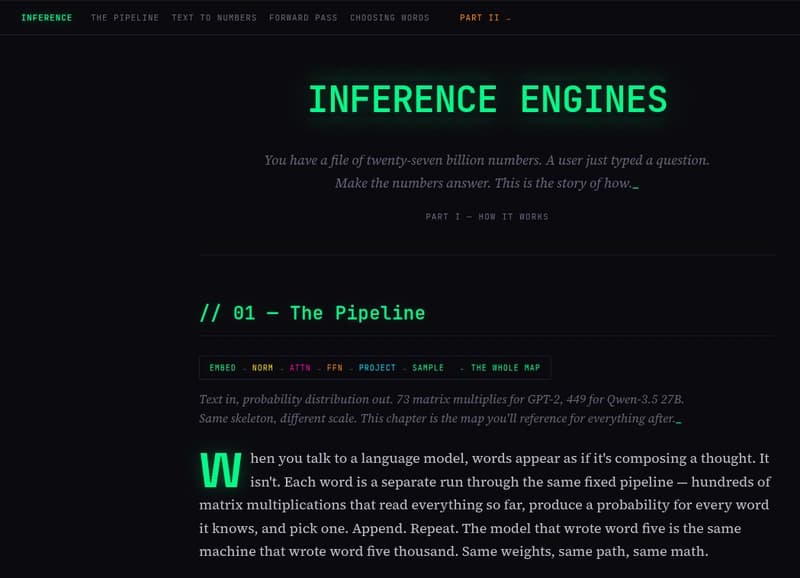
Inference Engines - A visual deep dive into the layers of an LLM
Dev.to
Surprised by how capable Qwen3.5 9B is in agentic flows (CodeMode)
Reddit r/LocalLLaMA


