
Riemannian and Symplectic Geometry for Hierarchical Text-Driven Place Recognition
arXiv cs.CV / 4/3/2026
💬 OpinionIdeas & Deep AnalysisModels & Research
Key Points
- The paper addresses text-to-point-cloud localization for robots by arguing that existing pooled global-descriptor methods lose discriminative scene information and underperform on capturing structured spatial cues.
- It introduces SympLoc, a coarse-to-fine cross-modal localization framework that aligns text with point clouds at three levels: instance-level, relation-level, and global-level.
- Instance-level alignment uses Riemannian self-attention in hyperbolic space to match individual object instances to textual hints.
- Relation-level alignment employs the Information-Symplectic Relation Encoder (ISRE) to encode pairwise object relations using Fisher-Rao metric and Hamiltonian dynamics for uncertainty-aware, geometrically consistent propagation.
- Experiments on KITTI360Pose report a 19% improvement in Top-1 recall@10m over prior state-of-the-art methods, indicating strong gains for hierarchical cross-modal retrieval.
Related Articles

90000 Tech Workers Got Fired This Year and Everyone Is Blaming AI but Thats Not the Whole Story
Dev.to

Microsoft’s $10 Billion Japan Bet Shows the Next AI Battleground Is National Infrastructure
Dev.to
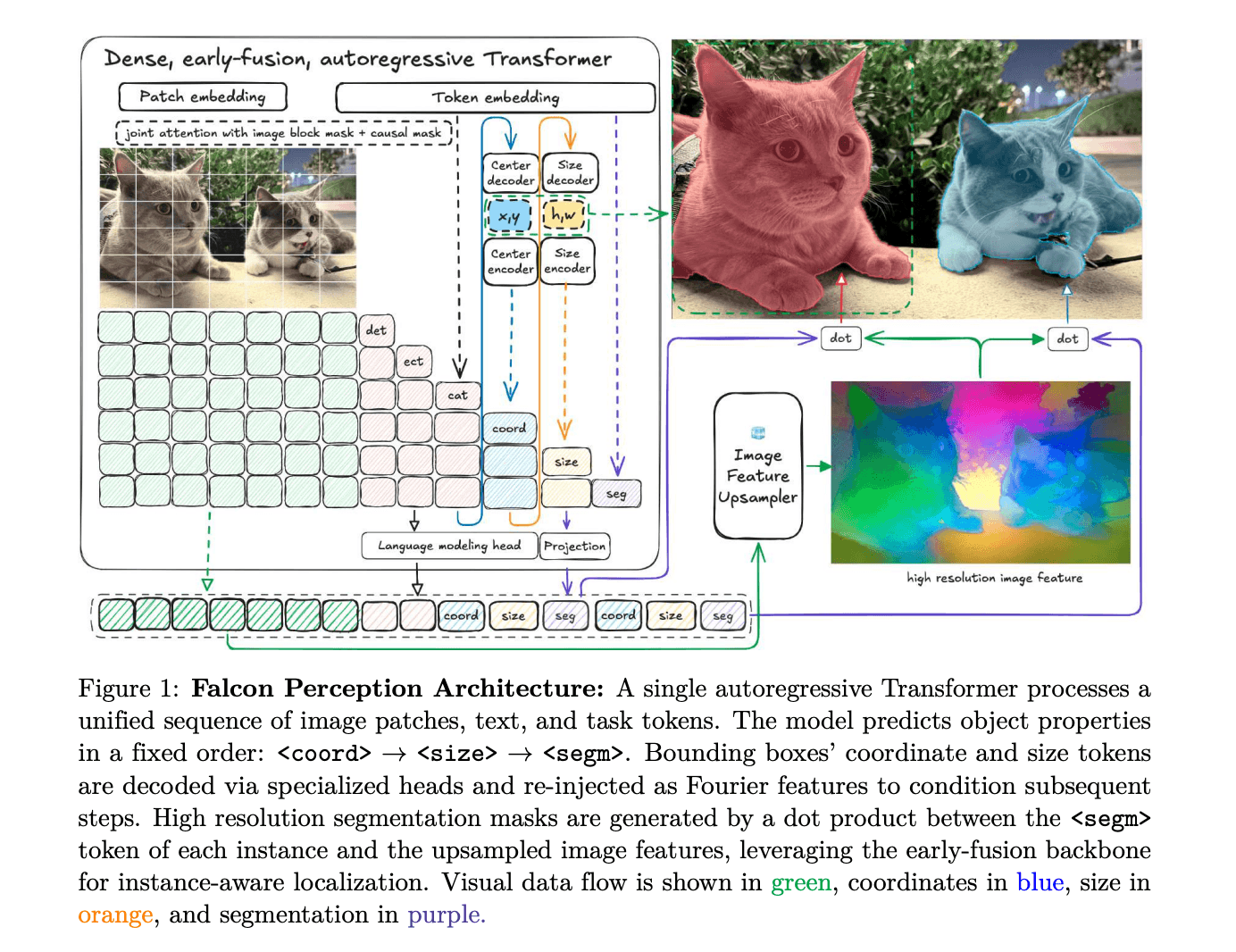
TII Releases Falcon Perception: A 0.6B-Parameter Early-Fusion Transformer for Open-Vocabulary Grounding and Segmentation from Natural Language Prompts
MarkTechPost

The house asked me a question
Dev.to

Precision Clip Selection: How AI Suggests Your In and Out Points
Dev.to


