
Softmax gradient policy for variance minimization and risk-averse multi armed bandits
arXiv cs.AI / 4/2/2026
💬 OpinionIdeas & Deep AnalysisModels & Research
Key Points
- The paper studies a risk-averse multi-armed bandit setting that prioritizes selecting the arm with the lowest reward variance instead of the highest expected reward.
- It uses a softmax-parameterized policy and introduces a new algorithm whose objective is based on an unbiased estimate constructed from two independent draws from the arm distribution.
- The authors prove convergence of the proposed variance-minimizing/risk-averse method under natural assumptions.
- Numerical experiments are provided to demonstrate practical behavior and to inform implementation choices, including extensions to settings that balance mean reward and variance.
- Overall, the work broadens bandit theory toward stability-focused decision-making and offers a method that can be adapted to general risk-aware optimization trade-offs.
Related Articles
v5.5.0
Transformers(HuggingFace)Releases
Bonsai (PrismML's 1 bit version of Qwen3 8B 4B 1.7B) was not an aprils fools joke
Reddit r/LocalLLaMA
Big Tech firms are accelerating AI investments and integration, while regulators and companies focus on safety and responsible adoption.
Dev.to
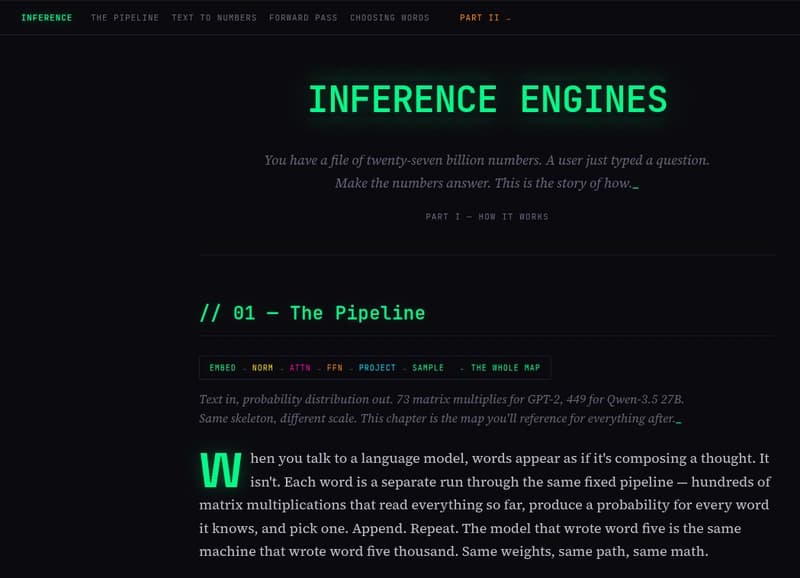
Inference Engines - A visual deep dive into the layers of an LLM
Dev.to
Surprised by how capable Qwen3.5 9B is in agentic flows (CodeMode)
Reddit r/LocalLLaMA


