
Do LLM-derived graph priors improve multi-agent coordination?
arXiv cs.LG / 4/21/2026
📰 NewsIdeas & Deep AnalysisModels & Research
Key Points
- The paper explores whether large language models (LLMs) can produce coordination graph priors for multi-agent reinforcement learning (MARL) from minimal natural-language descriptions of observations.
- These LLM-derived priors are injected into MARL using graph convolution layers in a GNN-based pipeline to guide how agents coordinate.
- Experiments on four cooperative scenarios from the Multi-Agent Particle Environment (MPE) show quantitative improvements over baselines ranging from independent learners to state-of-the-art graph-based coordination methods.
- The study finds the approach works even with relatively small open-source LLMs, with results indicating that models as small as 1.5B parameters can generate effective priors.
- An ablation across multiple compact LLMs is used to evaluate how sensitive the quality of the generated priors is to the chosen model.
Related Articles

Every time a new model comes out, the old one is obsolete of course
Reddit r/LocalLLaMA
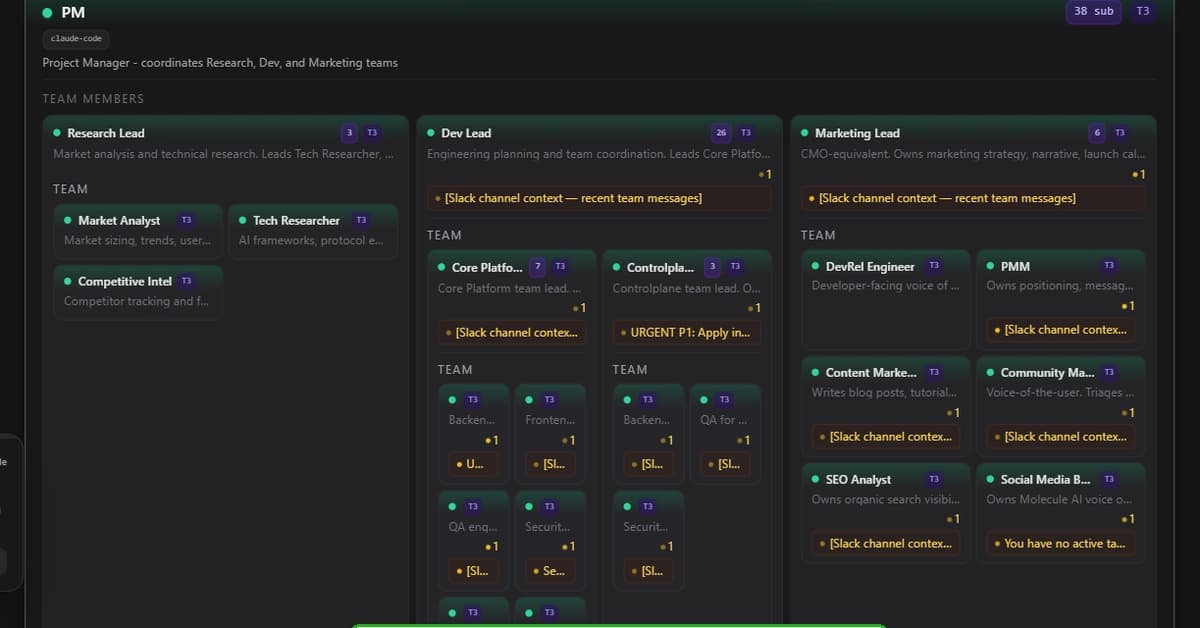
We built it during the NVIDIA DGX Spark Full-Stack AI Hackathon — and it ended up winning 1st place overall 🏆
Dev.to

Stop Losing Progress: Setting Up a Pro Jupyter Workflow in VS Code (No More Colab Timeouts!)
Dev.to
Building AgentOS: Why I’m Building the AWS Lambda for Insurance Claims
Dev.to

Where we are. In a year, everything has changed. Kimi - Minimax - Qwen - Gemma - GLM
Reddit r/LocalLLaMA


