
CircuitProbe: Predicting Reasoning Circuits in Transformers via Stability Zone Detection
arXiv cs.AI / 4/2/2026
📰 NewsSignals & Early TrendsIdeas & Deep AnalysisModels & Research
Key Points
- The paper introduces CircuitProbe, a method to predict “reasoning circuits” in transformer models from activation statistics in under 5 minutes on CPU, replacing costly brute-force sweeps that take about 25 GPU hours per model.
- CircuitProbe distinguishes two types of reasoning circuits: early-layer “stability circuits” detected via the derivative of representation change, and late-layer “magnitude circuits” identified using anomaly scoring.
- Across 9 models spanning 6 architectures (including 2025 models), the authors report that CircuitProbe’s top predicted circuit locations match the optimal circuit or are within 2 layers in all validated cases.
- A scaling study on the Qwen 2.5 family suggests duplicating the detected circuit consistently improves performance for models under 3B parameters, but degrades performance for 7B+ models, indicating a practical technique mainly for smaller LLMs.
- The method is data-efficient (as few as 10 calibration examples) and shows stable predictions across multiple languages (English, Hindi, Chinese, and French).
Related Articles

Black Hat Asia
AI Business
v5.5.0
Transformers(HuggingFace)Releases
Bonsai (PrismML's 1 bit version of Qwen3 8B 4B 1.7B) was not an aprils fools joke
Reddit r/LocalLLaMA
Big Tech firms are accelerating AI investments and integration, while regulators and companies focus on safety and responsible adoption.
Dev.to
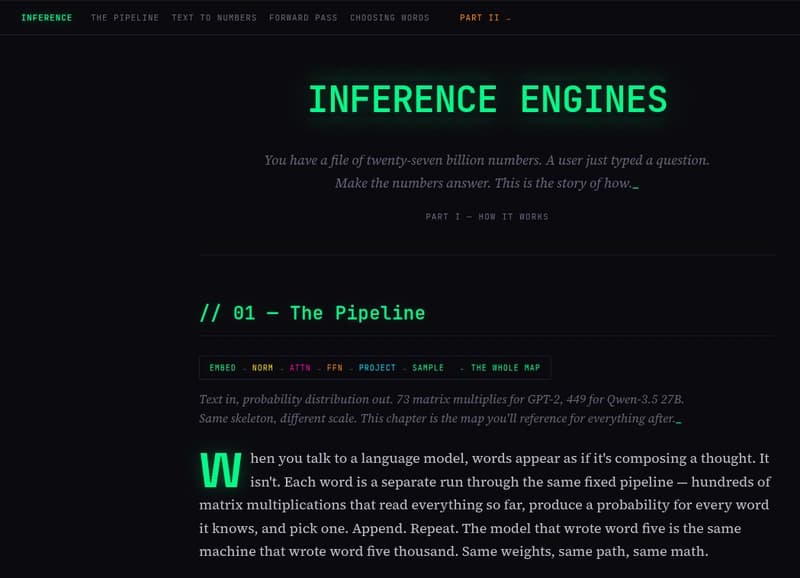
Inference Engines - A visual deep dive into the layers of an LLM
Dev.to


