
CounterScene: Counterfactual Causal Reasoning in Generative World Models for Safety-Critical Closed-Loop Evaluation
arXiv cs.RO / 3/24/2026
💬 OpinionIdeas & Deep AnalysisModels & Research
Key Points
- The paper introduces CounterScene, a framework for generating safety-critical driving scenarios by using structured counterfactual causal reasoning rather than heuristic adversarial perturbations.
- CounterScene identifies the causally critical agent and conflict types, then uses a causal interaction graph inside a conflict-aware interactive BEV world model to model inter-agent dependencies in closed loop.
- It generates counterfactuals via stage-adaptive minimal interventions that remove the agent’s safety margins while letting risk emerge through natural propagation, aiming to balance adversarial strength and realism.
- Experiments on nuScenes show improved long-horizon performance, including higher collision-risk emergence (12.3% to 22.7% over the strongest baseline) alongside better trajectory realism (ADE 1.88 vs. 2.09).
- The method also demonstrates stronger advantages over longer rollouts and generalizes zero-shot to nuPlan with state-of-the-art realism.
広告
Related Articles

Got My 39-Agent System Audited Live. Here's What the Maturity Scorecard Revealed.
Dev.to

The Redline Economy
Dev.to

$500 GPU outperforms Claude Sonnet on coding benchmarks
Dev.to

From Scattershot to Sniper: AI for Hyper-Personalized Media Lists
Dev.to
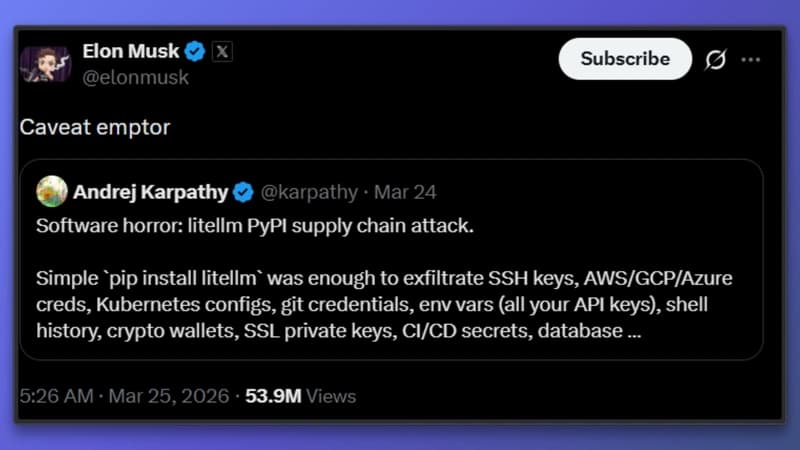
The LiteLLM Supply Chain Attack: A Wake-Up Call for AI Infrastructure
Dev.to


