
RANGER: A Monocular Zero-Shot Semantic Navigation Framework through Visual Contextual Adaptation
arXiv cs.RO / 4/2/2026
💬 OpinionSignals & Early TrendsIdeas & Deep AnalysisModels & Research
Key Points
- The article introduces RANGER, a zero-shot, open-vocabulary semantic navigation framework that enables embodied agents to localize targets and navigate using only a monocular camera rather than ground-truth depth and pose.
- RANGER addresses prior limitations by leveraging 3D foundation models and adding strong visual in-context learning (VICL) via environmental context from a short traversal video.
- The system improves efficiency without architectural changes or task-specific retraining by integrating keyframe-based 3D reconstruction, semantic point-cloud generation, VLM-driven exploration value estimation, and adaptive high-level waypoint selection.
- Experiments on the HM3D benchmark and in real-world settings report competitive navigation success and improved exploration efficiency, with superior VICL adaptability and no need for prior 3D mapping.
- Overall, the work targets practical deployment in complex environments by reducing sensor/ground-truth dependencies and using contextual visual priors learned from onboard observations.
Related Articles

Black Hat Asia
AI Business
v5.5.0
Transformers(HuggingFace)Releases
Bonsai (PrismML's 1 bit version of Qwen3 8B 4B 1.7B) was not an aprils fools joke
Reddit r/LocalLLaMA

Big Tech firms are accelerating AI investments and integration, while regulators and companies focus on safety and responsible adoption.
Dev.to
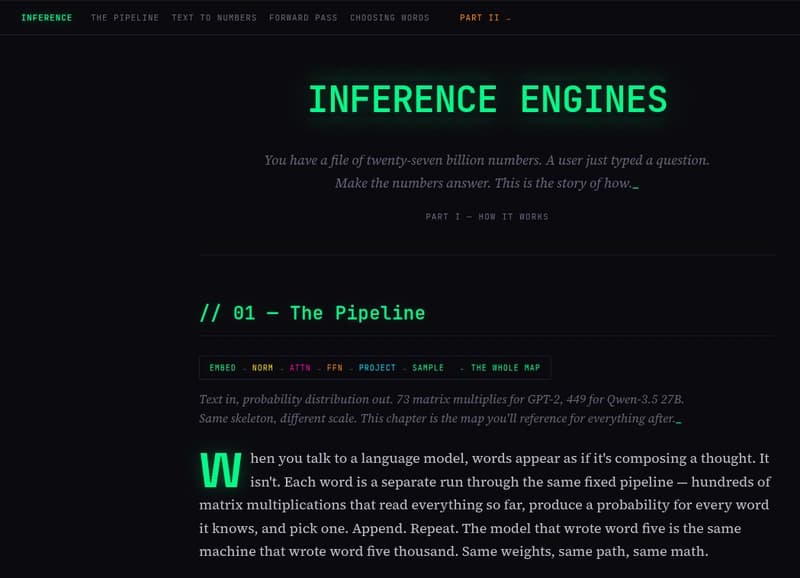
Inference Engines - A visual deep dive into the layers of an LLM
Dev.to


