
Towards Video Anomaly Detection from Event Streams: A Baseline and Benchmark Datasets
arXiv cs.CV / 3/27/2026
📰 NewsSignals & Early TrendsIdeas & Deep AnalysisModels & Research
Key Points
- The paper argues that event-based vision is a promising fit for video anomaly detection due to low redundancy, motion-centric signals, and privacy-preserving properties.
- It introduces the first set of synchronized event-stream and RGB benchmark datasets for event-stream-based video anomaly detection, aiming to unify the research direction.
- The proposed EWAD framework includes an event-density-aware dynamic sampling strategy to focus on informative time segments.
- EWAD also uses density-modulated temporal modeling to extract context from sparse event streams and an RGB-to-event knowledge distillation mechanism to strengthen event representations under weak supervision.
- Experiments across three benchmarks show significant gains over existing methods, and the datasets are planned to be publicly released.
広告
Related Articles
Got My 39-Agent System Audited Live. Here's What the Maturity Scorecard Revealed.
Dev.to
The Redline Economy
Dev.to
$500 GPU outperforms Claude Sonnet on coding benchmarks
Dev.to
From Scattershot to Sniper: AI for Hyper-Personalized Media Lists
Dev.to
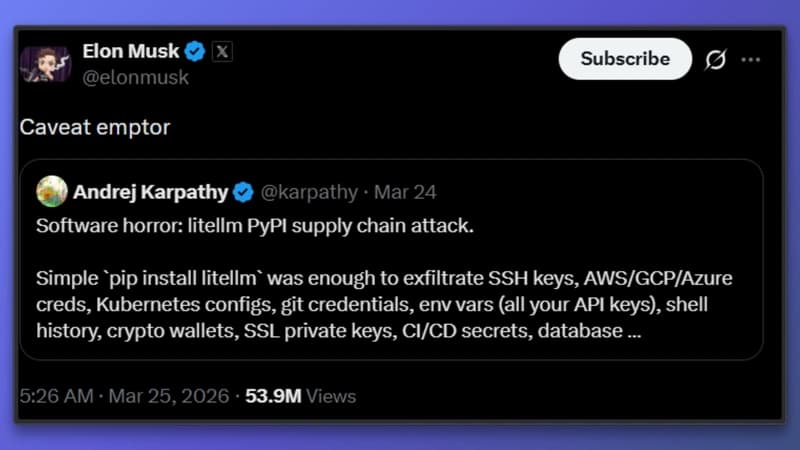
The LiteLLM Supply Chain Attack: A Wake-Up Call for AI Infrastructure
Dev.to


