
IWP: Token Pruning as Implicit Weight Pruning in Large Vision Language Models
arXiv cs.CV / 4/2/2026
💬 OpinionSignals & Early TrendsIdeas & Deep AnalysisModels & Research
Key Points
- The paper analyzes attention in large vision-language models through a “dual form” perspective, viewing attention as an implicit linear layer built from per-token rank-1 updates derived from each token’s key/value pairs.
- It formulates token pruning as selecting an optimal subset of these rank-1 updates to best approximate the original attention weight matrix, enabling a training-free pruning framework.
- For softmax attention in LVLMs, the authors derive a new pruning metric that jointly considers a token’s information magnitude and how much information it duplicates with other tokens.
- To select tokens efficiently using the new metric, the method introduces “Progressive Chunked Maximal Marginal Relevance,” aiming to improve the performance–efficiency tradeoff.
- Experiments reportedly show the approach achieves better performance versus computation reduction than prior pruning methods, while also providing an interpretive lens on existing techniques.
Related Articles

Black Hat Asia
AI Business
v5.5.0
Transformers(HuggingFace)Releases
Bonsai (PrismML's 1 bit version of Qwen3 8B 4B 1.7B) was not an aprils fools joke
Reddit r/LocalLLaMA

Big Tech firms are accelerating AI investments and integration, while regulators and companies focus on safety and responsible adoption.
Dev.to
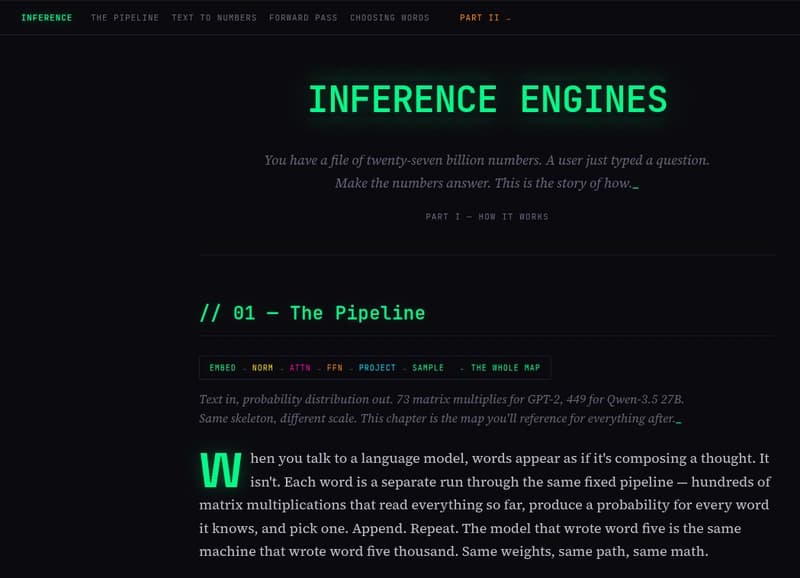
Inference Engines - A visual deep dive into the layers of an LLM
Dev.to


