
 | To save you from digging through their 244-page system card, I highly recommend checking out this video breakdown [Link:https://www.youtube.com/watch?v=PQsDXTPyxUg]—it perfectly breaks down why the "safety risk" excuse in my meme above is really just about astronomical compute costs. Anthropic is heavily pushing the narrative that Claude Mythos Preview is a god-tier model that is simply "too dangerous" to release because it can find zero-days in OpenBSD. But if you swipe to the second image (page 21 of their system doc), the illusion falls apart. They didn't just ask Mythos a question. They used uncensored checkpoints, stripped the guardrails, gave it extended thinking time, strapped it to domain-specific tools, and brute-forced it thousands of times at a massive compute cost (reportedly ~$50 per run). The single-shot probability of it finding a bug is likely fractions of a percent. This isn't a "dangerous" model; it's just an unscalable API cost wrapped in a PR campaign. We are already seeing this exact same agentic scaling in the open-source and local communities:
Even in the closed-source space, if you drop OpenAI's GPT-5.4 into the Codex app on the xhigh reasoning tier and let it run autonomously for 8+ hours with full codebase access, it is going to brute-force its way to 20 critical bugs while you sleep. Finding zero-days in 2026 is a factor of agentic tooling and massive compute budgets, not a magical leap in raw model intelligence. Don't let Anthropic's "extinction-level threat" marketing convince you that the open-source community is falling behind. [link] [comments] |
The Mythos Preview "Safety" Gaslight: Anthropic is just hiding insane compute costs. Open models are already doing this.
Reddit r/LocalLLaMA / 4/9/2026
💬 OpinionSignals & Early TrendsIdeas & Deep Analysis
Key Points
- The post argues that Anthropic’s “safety” justification for withholding Claude Mythos Preview is primarily a cover for extremely high compute costs rather than uniquely higher model risk.
- It claims the system-card breakdown shows Mythos finding zero-day-style bugs only after uncensored checkpoint use, removal of guardrails, extended thinking, domain tool integration, and large-scale repeated attempts (reportedly about ~$50 per run).
- The author contends that the probability of bug discovery in a single run is likely very low, implying the result depends on massive brute-force iteration rather than a leap in intelligence.
- It compares this approach to open and local communities using agentic “optimization loops” and parallel tool-call swarms (e.g., GLM-5.1 via OpenClaw and Kimi 2.5’s agent swarm mode) to scale search for issues.
- The piece concludes that zero-day discovery in 2026 is more a function of agentic tooling plus compute budgets than a gap the open ecosystem cannot match.
Related Articles

Black Hat Asia
AI Business
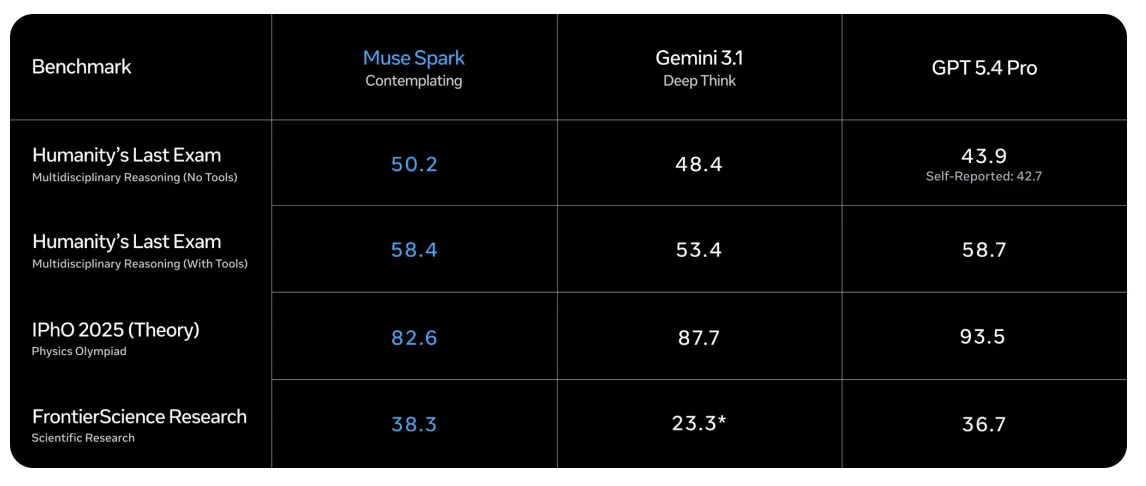
Meta Superintelligence Lab Releases Muse Spark: A Multimodal Reasoning Model With Thought Compression and Parallel Agents
MarkTechPost

Chatbots are great at manipulating people to buy stuff, Princeton boffins find
The Register
I tested and ranked every ai companion app I tried and here's my honest breakdown
Reddit r/artificial

Big Tech firms are accelerating AI investments and integration, while regulators and companies focus on safety and responsible adoption.
Dev.to


