
HalluClear: Diagnosing, Evaluating and Mitigating Hallucinations in GUI Agents
arXiv cs.AI / 4/21/2026
📰 NewsIdeas & Deep AnalysisTools & Practical UsageModels & Research
Key Points
- The paper introduces HalluClear, a suite aimed at diagnosing, evaluating, and mitigating hallucinations specifically in GUI agents where cascading failures are common in real deployments.
- HalluClear includes a GUI-focused hallucination taxonomy, a three-stage evaluation workflow to improve the reliability of VLM-as-a-judge using expert-annotated benchmarks and ensemble credibility estimation, and an intervention strategy using closed-loop structured reasoning.
- The mitigation approach supports lightweight continual post-training with cold-start initialization, targeting both generalist and GUI-specialist agents rather than relying solely on large-scale retraining.
- Experiments on representative agents and public benchmarks suggest that post-training with only about 9K samples can substantially reduce hallucinations and improve grounding and action fidelity.
- The work positions hallucination-focused tooling as a compute-efficient complement to industrial-scale scaling for building more robust GUI automation.
Related Articles

Black Hat USA
AI Business

¿Hasta qué punto podría la IA reemplazarnos en nuestros trabajos? A veces creo que la gente exagera un poco.
Reddit r/artificial
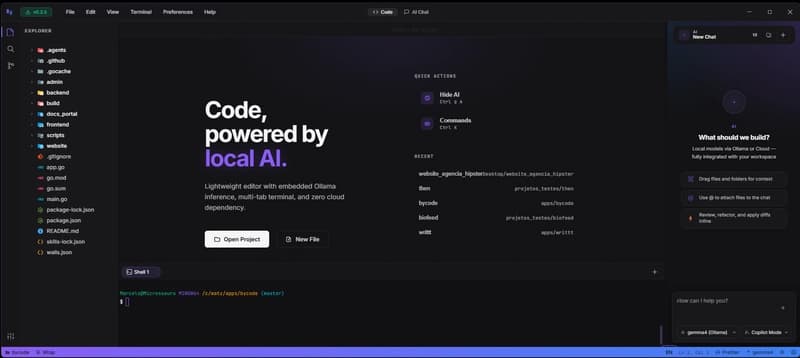
Why I Built byCode: A 100% Local, Privacy-First AI IDE
Dev.to

Magnificent irony as Meta staff unhappy about running surveillance software on work PCs
The Register
v0.21.1
Ollama Releases


