Jen Pahlka, author of Recoding America and founder of the Recoding America Fund joins ChinaTalk to discuss:
Why AI could help governments cut through regulatory cruft, but can’t replace the political will needed to reform it,
How state-level competition and experimentation could accelerate government reform,
Why even obvious bureaucratic fixes are difficult — nearly every dysfunctional policy has a constituency that benefits from it,
The Recoding America Fund’s mission to build a cross-ideological coalition to modernize the government’s operating model.
Plus, we talk about 7,119 pages of New Jersey unemployment insurance regulations, why drastically cutting the defense budget might improve national security, and why the toughest questions about public programs aren’t technical, but fundamentally political.
Listen now on your favorite podcast app.
What AI Can and Can’t Fix in Government
Jordan Schneider: Jen Pahlka, American hero. Welcome to ChinaTalk.
Jen Pahlka: It’s really an honor to be here, though you’re overstating things already.
Jordan Schneider: Where should we begin? I want to talk about the Recoding America Fund and the bright future you envision for American governance. If this all goes great, what can we expect our federal, state, and local governments to accomplish?
Jen Pahlka: That’s a good question. We tend to go straight to the negative, and there’s plenty of negative to talk about — but people are driven more by wanting to get to a good place than away from a bad one. Government is supposed to meet people’s needs, both individual and societal, and we’re really struggling to do that right now. We’re stuck trying to get 10% better here or 15% better there, instead of asking — what do we actually need to leapfrog to? Whether it’s administering a social safety net that protects people in vulnerable times or deterring adversaries, we need to start thinking in terms of actually meeting the moment rather than moving slightly ahead from where we are today.
When I started in government reform in the late 2000s and early 2010s, the basic argument was that if you want to meet people’s needs, you have to recognize that their expectations have changed. They expect to be able to do business online. If there’s a real gap between how people get things done in their private lives and the burden we impose on them when dealing with government, that is not good for democracy. If we can close that gap — which AI has now blown wide open — people will support a government that works, and they will care about institutions that work for them.
Jordan Schneider: We’re running this in parallel with an episode featuring Kevin Hawickhorst from FAI on the history of the civil service. There’s this idea that we had a golden age in the early-to-mid 20th century, after Progressive Era reforms kicked in, with truly excellent organizations and people. On one hand you have that degradation, but on the other, the expectations of what government should do have also increased as private-sector service delivery has dramatically improved over the past 50 years. Do you want to apportion blame between those two factors? Is there anything else going on?
Jen Pahlka: What you had was a very effective administrative state — the glory days Kevin talks so eloquently about — that was fit for purpose for that moment. Part of why it was fit for purpose is that it built in its own sense of renewal. Kevin talks about a practice under the Eisenhower administration of constantly renewing and streamlining business processes — it was called “work simplification.” You read that and think, that is exactly what we need now. It doesn’t require much translation to the current era.
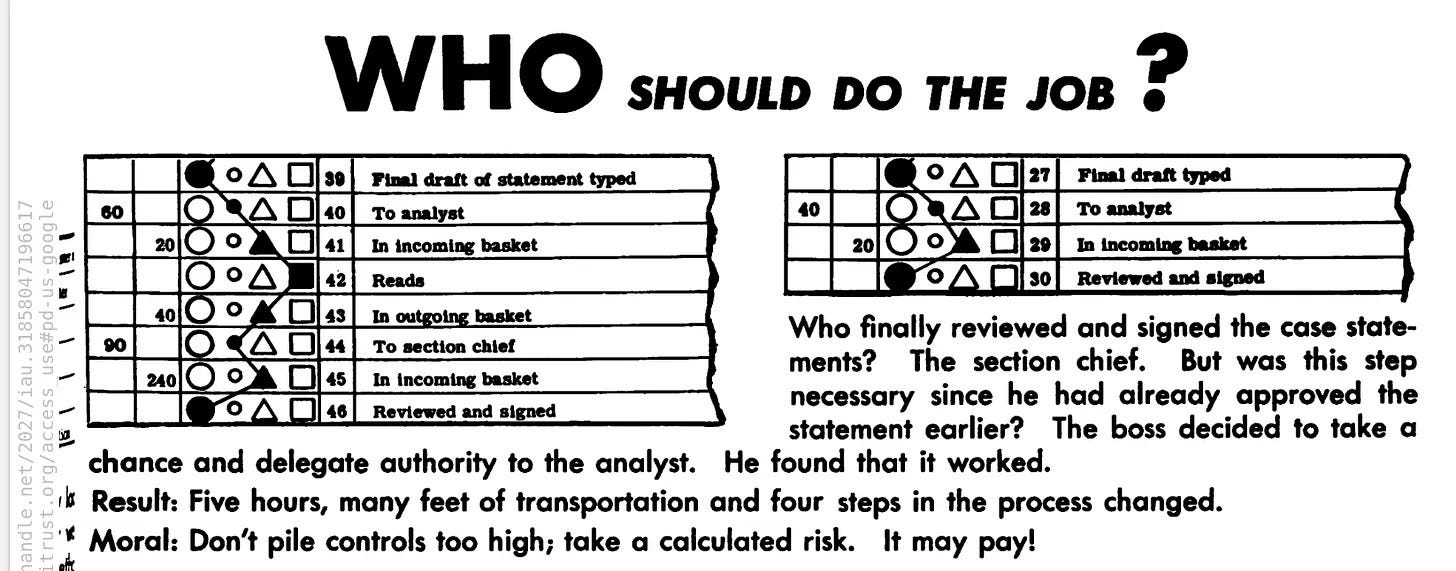
What we lost was that notion of constantly re-examining things. We got lazy and let policy and process accumulate like layers of cruft — archaeological layers you can dig back through. Our legislators and policymakers came to believe that success means adding rules, mandates, and constraints, instead of constantly asking — what should this process look like? What do we need to remove to make it effective? It is, in some sense, a return to past practices, but those past practices were good precisely because they weren’t frozen in time.
Jordan Schneider: You blurbed a paper by Luukas Ilves called The Agentic State. It analyzes transformation through 12 functional layers. The six implementation layers where agents can deliver immediate value include — “public service design that becomes proactive and personalized; workflows that self-orchestrate; policymaking that adapts continuously based on evidence; regulatory compliance that operates in real time; crisis response that coordinates at machine speed; and procurement systems that negotiate autonomously within policy constraints.” That seems pretty compelling.
Jen Pahlka: Luukas said it very well. And the next piece covers six enablement layers that go with that — complicated, but important.
Jordan Schneider: I want to stay on this question of the path forward. We have 75 years of accumulated cruft, Nader-era pushback, and deliberate erosion of state capacity.
Jen Pahlka: We have undone state capacity. I would agree with that. But we’ve undone it by doing too much in a certain way. It’s primarily the laziness of not cleaning up our messes rather than the intentional undoing of anything. In some ways, the intentional undoing of what has been done would create more state capacity.
Jordan Schneider: The human man-hours that would take to undo this…You recently did a show with Greg Allen where you talked about the 7,000 pages New Jersey unemployment insurance has to operate under.
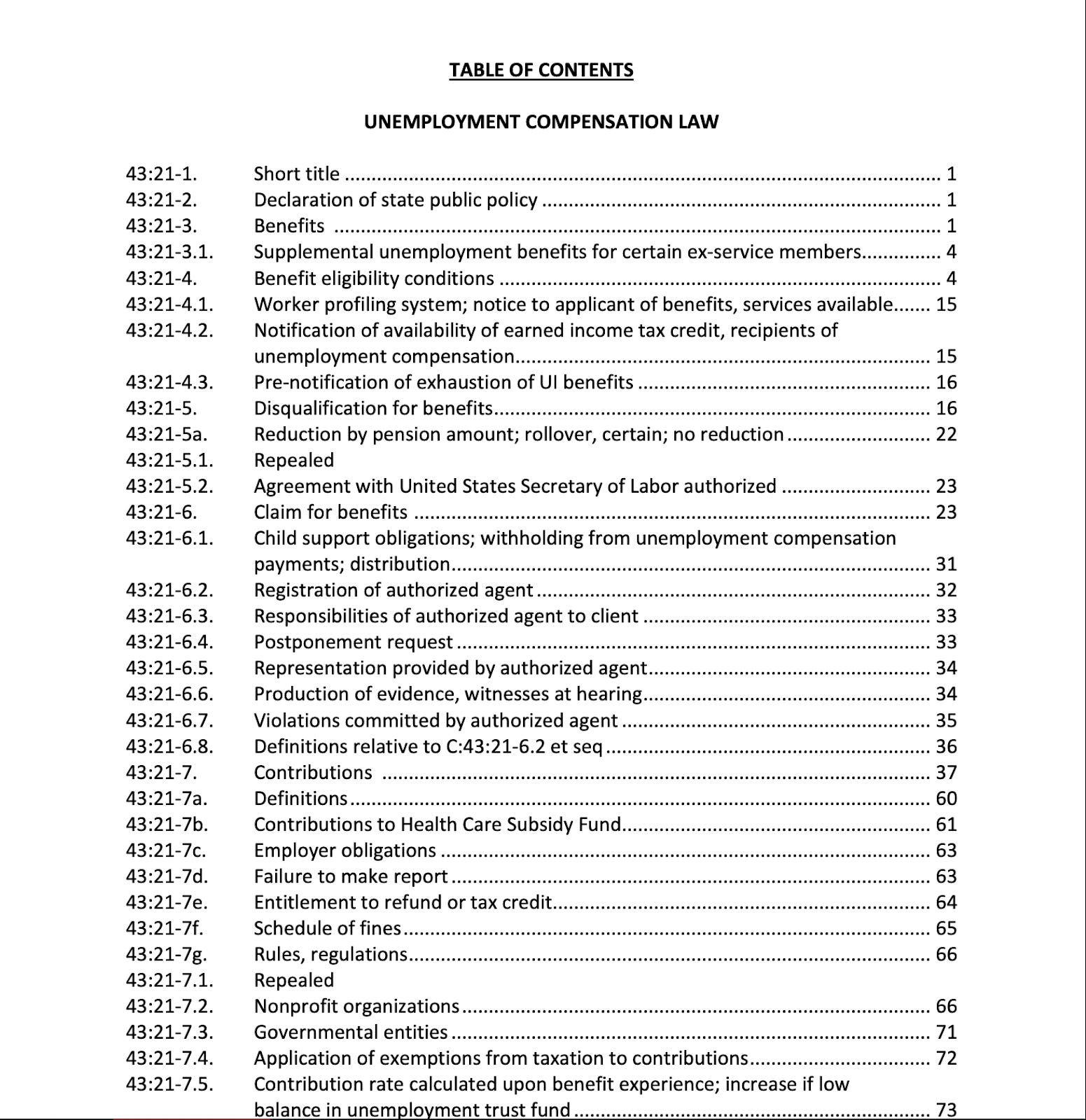
Jen Pahlka: 7,119 pages of active UI regulations.
Jordan Schneider: Unwinding that would take tens of thousands of man-hours to map and rationalize — or you just have an AI get 95% of the way there. It seems like the only way out.
Jen Pahlka: The good news is that the moment we arrive at the realization that 7,119 pages creates an unadministrable program — and I think we’re starting to get there — the tools have arrived to make that problem a lot easier. That brittleness is especially dangerous for a program that operates at low volumes day-to-day but needs to scale 10x or 20x in claims during a crisis. Scalability is a core requirement.
The pushback I get is that AI can’t be in the driver’s seat. But people can be in the driver’s seat if they choose to use these tools. The AI cannot do anything about the political will required to unwind the memos, guidance, policy, regulations, and statutes that need to be unwound. But we haven’t really tested that political will, because nobody has been able to articulate what the target should look like. How many pages should it take to describe a program that gives someone money for a certain number of weeks under certain circumstances? It’s certainly not 20 pages, but it needs to be a lot less than 7,000. Until we put forward what we think that should look like, we haven’t tested the will of our political leaders to get us there.
Jordan Schneider: Two things could block this future — politics and fear of AI. I’m relatively optimistic on the fear side. I remember people being terrified of Uber and Airbnb. The daily utility people are getting from these tools is only going to grow — everyone is going to have a personal assistant, and maybe part of the answer is that people just outsource their government interactions to their AI agent, which cushions some of the pain, though that doesn’t answer whether the unemployment check is actually coming. Still, I think demand for these tools will grow from politicians, government workers, and the public alike. Are people going to get over their fear?
Jen Pahlka: People will. The question is whether we will have already put too many rules in place — such that the cultural barriers dissolve, but the statutory and regulatory barriers were locked in before we really understood what was possible.
When the Biden AI executive order came out and OMB was developing its guidance, Dan Ho and I submitted a letter that restated a paper I wrote called “AI Meets the Cascade of Rigidity.” The concept is that while people can create guardrails that sound perfectly reasonable on paper, in a risk-averse, overburdened bureaucracy, those guardrails don’t function as guardrails. They function as barriers you simply cannot overcome.
The unemployment regulation example is actually a useful corrective to AI fear, because it illustrates what AI genuinely can and cannot do. It can rewrite the law, but it cannot get that law passed. It can rewrite policy, but it cannot get that policy enacted. Humans have to do that. If you want an example where there’s no fear that AI will take over — because it structurally can’t — that’s it. You realize at the end of the day that it is a tool in the hands of people trying to make government better, and that the binding constraint isn’t the AI. It’s our political system.
Jordan Schneider: What didn’t exist in 2024, or even for most of 2025, is the idea that software is basically free — or that software engineering productivity is now 10x or 100x, and people who never imagined themselves writing code can now build tools.
Jen Pahlka: It’s extraordinary — and yet basically the entire federal government and most state governments are not adapting to it. They still have contracts with vendors that have people writing code. Those people may or may not be using AI coding tools, partly because policy clarification hasn’t come down. But even setting that aside, those contracts don’t account for the dramatic drop in the cost of software development. It’s going to be decades before government actually pays less for software — and right now we’re probably going to start paying more.
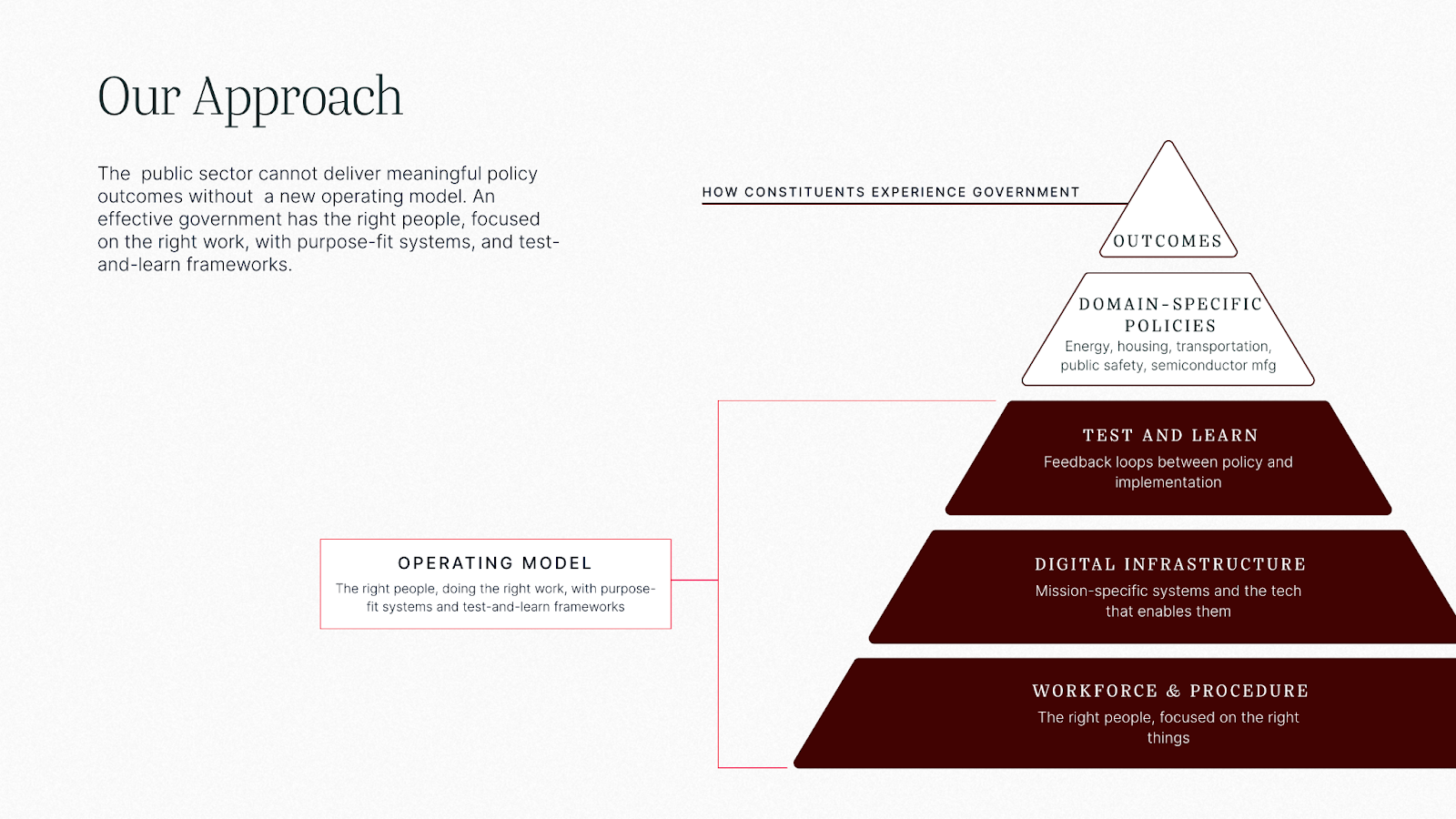
We should be running a five-alarm fire. How does government get the software it needs dramatically faster and cheaper? That’s not entirely what’s happening yet — and I don’t say that to dismiss the great leaders I meet who are pushing hard on this. But they are held back not just by AI guidance, but by procurement systems, contracting rules, legal reviews, and the legacy ways of doing things that, in the Recoding America framework, sit at the very bottom of the Maslow’s hierarchy of government needs. These foundational processes don’t look like they have anything to do with AI on a day-to-day basis — but they fundamentally either enable or constrain government’s ability to enter an AI era. And at the very bottom of that pyramid, everything rests on one question — do we have a functioning workforce? Is our civil service fit for purpose for this era?
Recoding America for the AI Era
Jordan Schneider: Give us a 30-second introduction to Recoding America.
Jen Pahlka: Here’s a little backstory. My book Recoding America came out in 2023, and as I went around talking about it, people kept saying that I was describing the dysfunction of government and how critical it is to fix it, yet there’s no political power or momentum behind the recommendations — they’re ideas without a constituency. It was Kumar Garg at Renaissance Philanthropy who said the way to put teeth on this agenda is to raise funds and act as a field catalyst for government reform. Not the flavor of reform we’ve had over the past couple of decades, but reform that leapfrogs government into an AI era. Whatever you care about — deterring adversaries, the abundance agenda, a functioning social safety net —
Jordan Schneider: Or small government.
Jen Pahlka: Small government cuts across all of it. But whether your issue is education, housing, transportation, or criminal justice, what you realize is that you can bring in better policy and still not get the intended impact. That’s because, just as Maslow’s hierarchy says you can’t achieve self-actualization if you’re not fed and housed, you can’t iterate meaningfully on policy when the basics aren’t covered. The basics are the operating model of government — and ours is an industrial-era model that was excellent for its time. We slapped websites on the front end of it when the internet arrived without fundamentally adapting it, and now we’re entering the AI era needing to leapfrog it entirely.
The thesis of the Recoding America Fund is that if you want government to achieve its policy goals, it needs to hire, manage, and retain the right people — which means civil service reform. Those people need to be focused on the right work — which means procedural reform and cutting the policy cruft we discussed. They need purpose-fit systems, including but not limited to AI. And they need to operate in test-and-learn frameworks rather than the waterfall methodology that infuses everything government does. We’re trying to catalyze a field of civil society organizations that push and enable government to make that leap.
Jordan Schneider: On the vision — you walk through many policy areas where people have strong feelings and don’t always agree. How close are we to the Pareto frontier of effectiveness before we start hitting genuinely ideological tradeoffs? Can we keep the middle 75% of the political spectrum aligned on this agenda?
Jen Pahlka: Let me qualify first by noting that we naturally focus on the federal government, but we also work with states — and updating an operating model is largely independent of whether you’re talking about education or national defense. States are valuable because you have more opportunities to find where the energy is, prove it works, and let other states and cities adopt it. The federal government can learn from that too. The classic line applies — the future is here, it’s just unevenly distributed.
One area where people will have very strong feelings is civil service reform, which hasn’t meaningfully happened since 1947. The Civil Service Reform Act of 1978 tinkered around the edges more than pulled us into the paradigm we need. Civil service reform is going to be hard, especially given legitimate concerns about protecting civil servants’ independence. We have to be careful that in the interest of building a properly manageable workforce, we don’t create massive turnover with every change in administration and a culture of fear. That would be a very bad outcome.
That said, there are already real opportunities at the state level. North Carolina’s legislature looked at their system, declared it unfit for purpose, and asked the state HR director to propose a complete reboot — a major, major reform. We’ve been fortunate to support that with fellows helping push their thinking. That’s the dream — working on a real civil service system. Since we believe in test-and-learn frameworks, it’s great to do this with North Carolina while we look for opportunities to replicate it elsewhere. You need to start building the muscle and riding the bike around the block while you wait for the larger policy windows to open.
Jordan Schneider: That felt like a dodge — let me try again. Take our 7,000 pages of unemployment insurance regulation. Let’s say 75% of it is just dumb and silly. Then you start hitting real tradeoffs. Do we prioritize people with children? Do claimants have to prove they’re looking for work? And we recently saw a reconciliation bill where the projected Medicaid savings were predicated on new regulatory cruft intentionally designed to create friction so people don’t access benefits. Is your sense that we can go really far or 50% of the way to our beautiful functioning future? Like at what point does this agenda hit the wall of principled disagreement that only legislators and elections can resolve?
Jen Pahlka: I won’t give you a percentage because I genuinely don’t know, but you want to distinguish between things like Medicaid work requirements — which are deliberately designed to make the system operate poorly — and things that are just capture by the status quo that accidentally make things worse without intending to.
Even in that second, less politicized category, change is still hard, because there are always people whose business model is built around the dysfunction. One of my learning arcs over the past 15 years has been moving away from the belief that you can wash all of that away as soon as you demonstrate how dumb it is. There are constituencies for every dumb thing, even when it’s not as cynical as intentionally rationing Medicaid dollars through friction — which is just a terrible way to allocate scarce resources.
The deeper conclusion I’ve reached is that in a better world, instead of legislating down to an incredible degree of procedural specificity, you tell agencies here’s the goal, and give them far more freedom to get there. That’s what we call outcomes-driven legislation — the PopFox Foundation has a great outline of what that looks like. We could move much further in that direction and still not be at the ideal.
The real problem is that we often have outcomes-driven legislation’s opposite precisely because legislators don’t actually agree on the outcome. They can agree on the rules of the system, and then you’re locked into administering those rules. One person thinks the point of a program is to make sure people don’t end up in the emergency room and another thinks it’s to keep costs down. They’re not necessarily mutually exclusive, but what they’ve agreed on is the rules, not actually the goal. That is going to be a significant obstacle to where we want to go.
The positive future is one where we are much clearer on goals and have the agency tools to tack toward them, rather than just executing steps A through B through C in a waterfall. On the role of politics — yes, ultimately, voters will have to reject things like Medicaid work requirements. The problem is that right now, we don’t have a responsive feedback cycle. Implementation takes so long that voters are always reacting to something two administrations ago — there’s no perceived correlation between a harmful policy and electoral consequences.
We need to speed up implementation so that when you do something good or bad, you actually feel the consequences in the next election.
Jordan Schneider: So you won’t give the number. But I think it’s about 80% you can fix before you hit genuinely hard ideological trade-offs.
Jen Pahlka: I love that number, and you may be right about the percentage of stuff that’s more trivial. But we still have to face the capture embedded even in that 80% — it’s much less, but it’s there. We still have to get people into a trade-off mindset.
Jordan Schneider: So — how to make legislators’ jobs more fun. We have our 7,000 pages. Let’s say 6,000 of them are just dumb requirements everyone agrees can be AI’d away — fax mandates, wet signature requirements, that kind of thing. What excites me is the idea of teeing up the actual decisions — here are the 10 questions where, if you give me answers, I can reach the next Pareto-optimal policy improvement. The AI figures out all the mechanical stuff. It’s not up to the AI to decide whether single mothers should get more than two-parent households or how to structure alimony. But once you get into that territory, the political valence of the AI doing the teeing-up gets really tricky.
Jen Pahlka: Do you mean teeing up the policy decision, or making a benefit determination?
Jordan Schneider: I mean the model not just doing the boring stuff, but facilitating the discussion, doing the modeling, and ultimately generating recommendations on the hard normative questions. We have the CBO, which is the closest thing to objective scoring we have — imperfect, but both sides interact with it as a form of shared truth. I can imagine a version of the CBO where an AI does that for an enormous swath of tradeoffs and decisions, with models rather than beleaguered congressional staffers providing the simulations, ground truth, data, and projections. It could be a really strange future.
Jen Pahlka: It will be strange. By the way, I love the framing of “let’s make the legislators’ jobs more exciting.” I’m going to use it and pitch that.
But one thing that excites me is that it gives you the ability to actually interrogate goals. You can ask much more easily now — will this policy intervention, properly implemented, help more people return to work? In the unemployment insurance context — if one goal of UI is to prevent people from falling into deeper poverty so they can get re-employed — that whole world is changing dramatically right now. We need to be asking, is that one of the goals? And if so, does the way we verify the terms of someone’s separation from their last job actually advance that goal? Enormous amounts of administrative burden go into that question, and it might not make much difference to what the program is actually trying to achieve. Not as damaging as Medicaid work requirements, but still significant. We need to ask, what is the right design of this program if what we actually want is to prevent chronic unemployment?
Jordan Schneider: Coming back to my idea that people will embrace these tools — maybe this is part of the amazing future — but the experience you have with Claude Code where it keeps asking for permissions and you just say “sure, just do it,” within three to five years, the things models will strictly dominate humans on — especially a lot of government work, which is just taking rules and applying them — we’re going to be handing a lot over to technology. Government will be slower, but in many corners of life, you’ll be delegating to your model. And we still have elections and legislators.
Constraints, Competition, and Crises
Jen Pahlka: But that’s exactly it — when the moment comes where it is just patently obvious that handing that over is the right thing to do, will we have already constrained ourselves? We’re sitting in New York, which has passed a law saying you cannot change a public servant’s job because of AI. I understand the logic. But it could fundamentally exacerbate the gap between public and private sector effectiveness in ways that are devastating.
Jordan Schneider: Those dumb constraints will go the way of the dodo when Pennsylvania and New Jersey don’t adopt them and end up literally ten times more effective. Though it took phonics a very long time to get out into the world, so who knows?
Jen Pahlka: No, that’s actually true — something that was very clearly the right answer took a minute.
Jordan Schneider: At least at the state level, you have that competitive dynamic. I’m thinking ahead to 2030, when everyone’s gotten it, and we’ve already moved past most of the ideological debates because AI has gotten us 95% of the way there. That’s the future we’re working toward. Are people genuinely freaked out about this?
Jen Pahlka: That’s one of the reasons having 50 states is great. New York might pass a law, that I think is a terrible mistake, but they’ll hopefully be forced to revisit it when their neighbors are kicking their ass.
Jordan Schneider: That competitive dynamic will drive proliferation in the private sector. The New York–New Jersey–Connecticut–Pennsylvania feedback loop is slow but real. For the federal government, we have elections every two years — is that what unlocks AI-era government services? We had a version of that with DOGE, though I’m not sure if that’s the future. Then there’s the defense establishment, which confronts this daily in the intelligence community, and we seem to be in a conflict every month now. Where do you put different institutions on the spectrum from “constant competitive pressure to modernize” to “the IRS”?
Jen Pahlka: It’s interesting. The fact that we’re in a near-constant state of conflict ought to kick us into crisis mode, and our history is that we act in crisis. The transformation into the digital era has really only come in leaps. Healthcare.gov is the perfect example — I was in the White House at the time, trying to stand up what became US Digital Service (USDS), and it was moving very, very slowly. Truthfully, I don’t think it would have happened without the crisis of the healthcare.gov launch.
Being in a hot war with Iran might change things at the Pentagon. But one core problem is that we just keep giving the defense establishment more money. Constraints drive creativity — they’re part of transformation. I was sitting next to a very senior Air Force leader at an event once and said that after my four years on the Defense Innovation Board, my conclusion was that you could only defend the country better by cutting the budget, because the bigger these projects get, the more rules accumulate, the slower everything moves, and the more people are touching it. I half-apologized because I felt I was insulting him. He said, “No. Let me edit what you just said. A cut is not enough. We’ve had that with sequestration and it just means a haircut across the top — everyone cuts all the wrong things. You need to cut the budget by half.” I asked whether he was saying the department would be more effective with half the budget. He said, “Absolutely.”
So we need the kind of crisis that forces us through more streamlined channels. Will war do that? Maybe — but there’s enough chaos right now that it’s distracting us from the core work of making the DOD fit for purpose. What we want isn’t half the defense capability — we want double the capability. We want to break out of 25-year acquisition cycles and stop delivering ships that are obsolete by the time they’re built. The way you get there is to contract the resources so that people are forced into more streamlined channels.
Jordan Schneider: How much of the slowness and dysfunction do you attribute to political economy? If software costs one-fifth as much, the contractors currently billing for it lose political heft to slow things down and optimize for their business models rather than the country’s. Is that a big part of the problem?
Jen Pahlka: It’s an interesting field in that some of the loudest voices for transformation are actually vendors — not the Beltway Bandits, but insurgents making the case for speed and what you might call “attritable mass” — lots of small drones instead of large platforms. That said, there are real concerns about the new breed of vendor getting in on the capture game. It’s just the natural cycle. But yes — big to medium part of the problem.
Call to Action
Jordan Schneider: You guys have $120 million?
Jen Pahlka: No. We’re fundraising. We have just under $40 million and will be raising the rest over the next couple of years.
Jordan Schneider: What’s the email?
Jen Pahlka: jen@recodingamerica.fund.
Jordan Schneider: What does going from $40 million to $120 million get you?
Jen Pahlka: We’re a six-year fund, and it buys the ability to plan and execute over that full arc in a way that’s meaningful and sustainable. We’ll check in at the three-year mark and ask whether we need to go bigger or adjust course — based not just on our own progress, but on the policy windows that open up.
The deeper point is that there has never been a real field of state capacity. I was part of the world loosely called civic tech, and there are good government reformers and congressional modernization groups, but there’s never been a center of gravity — a set of organizations, a community that extends beyond those organizations to people, legislators, and media — all pointed toward the same future.
What we need is people from the left, center, right, MAGA, and progressive wings all saying — we might not agree on exactly what civil service reform looks like, but we know we need it, and there’s common ground in the middle. Everyone from MAGA to progressives actually agrees on more than people realize. Get Elizabeth Warren talking about it, get Senator Young talking about it; get the states talking about it — that creates a critical mass for something that hasn’t been on the table in decades. You cannot build that on one year of funding with no visibility into the next.
Jordan Schneider: How does this work feel compared to, say, the healthcare.gov rescue or writing the book?
Jen Pahlka: It feels inevitable, frankly. Writing the book would have been pointless if I wasn’t going to do this work. We live in interesting times that worry me quite a bit, but it’s good to have something I fundamentally believe needs to happen — something I can stay focused on regardless of what’s dominating the headlines. I can’t do much about most of the headlines, but I can say, let’s not take our eye off the ball. We know we need civil service reform. That’s my lane, and I’m staying in it.
Jordan Schneider: Does building a national coalition feel different from the operational work — the healthcare.gov-era stuff, building USDS?
Jen Pahlka: I should note I wasn’t on the healthcare.gov rescue team directly — I was standing up USDS from OSTP at the time, and we retroactively claimed credit for it. Wonderful people did that work, not me. But to your question — they all feel part of a whole. A better example for me is the unemployment insurance work I did during the pandemic. When you see those dysfunctions up close, you realize they cannot be solved from a high perch that misses what actually happens day-to-day inside an agency.
If you’ve actually fought the battle and carry the scars — and the frustration — you’re not the only one who eventually concludes you have to go upstream. I visited military bases on the Defense Innovation Board and sat side by side with people struggling under incredible constraints to do things that shouldn’t have been that hard. That experience informs the strategy at every layer up. This is the highest layer I’ve operated at, but I bring everything from those earlier battles. The goal is that our strategy stays grounded in actual problems rather than abstract ideas — truly designed for what we’re trying to solve.
Jordan Schneider: Besides asking for funders — you’re hiring, you’re taking pitches — what other calls to action do you have?
Jen Pahlka: Open positions are on our LinkedIn. We’re actively looking for major funders. We’re also looking for people who can connect us with state legislators and state leaders. And — you pointed at the camera when I said media — we need to be telling a different story. People who want to engage with this parallel universe of administrative state renewal, come to us. We’ve got stories to point you at. Shaping that narrative will bring more people into the mindset you started this conversation with, not just “how is government broken today,” but “what is the future we’re building toward, and how do we start imagining ourselves there?”
ChinaTalk is a reader-supported publication. To receive new posts and support our work, consider becoming a free or paid subscriber.