
Bridging Discrete Planning and Continuous Execution for Redundant Robot
arXiv cs.RO / 4/3/2026
💬 OpinionIdeas & Deep AnalysisModels & Research
Key Points
- The paper addresses a common failure mode of voxel-grid reinforcement learning planners on 7-DoF redundant robot arms, where point-wise numerical inverse kinematics execution causes step-size jitter, abrupt joint transitions, and instability near singularities.
- It introduces a “bridging” framework that leaves the discrete planner unchanged while stabilizing both the discrete action representation (step-normalized 26-neighbor Cartesian actions plus geometric tie-breaking) and the continuous execution layer.
- For execution, it proposes a task-priority damped least-squares inverse kinematics (TP-DLS) approach that treats end-effector position as the primary task and projects posture and joint-centering objectives into the null space.
- Using trust-region clipping and joint velocity constraints, the method substantially improves results on a 7-DoF manipulator, including raising dense-scene planning success from ~0.58 to 1.00, shortening path length from ~1.53 m to ~1.10 m, keeping end-effector error under 1 mm, and reducing peak joint accelerations by over an order of magnitude.
- Overall, the work shows that careful coupling of discrete planning outputs with constrained, priority-based continuous IK can significantly improve the real-world smoothness and stability of RL-generated robot trajectories.
Related Articles

90000 Tech Workers Got Fired This Year and Everyone Is Blaming AI but Thats Not the Whole Story
Dev.to

Microsoft’s $10 Billion Japan Bet Shows the Next AI Battleground Is National Infrastructure
Dev.to
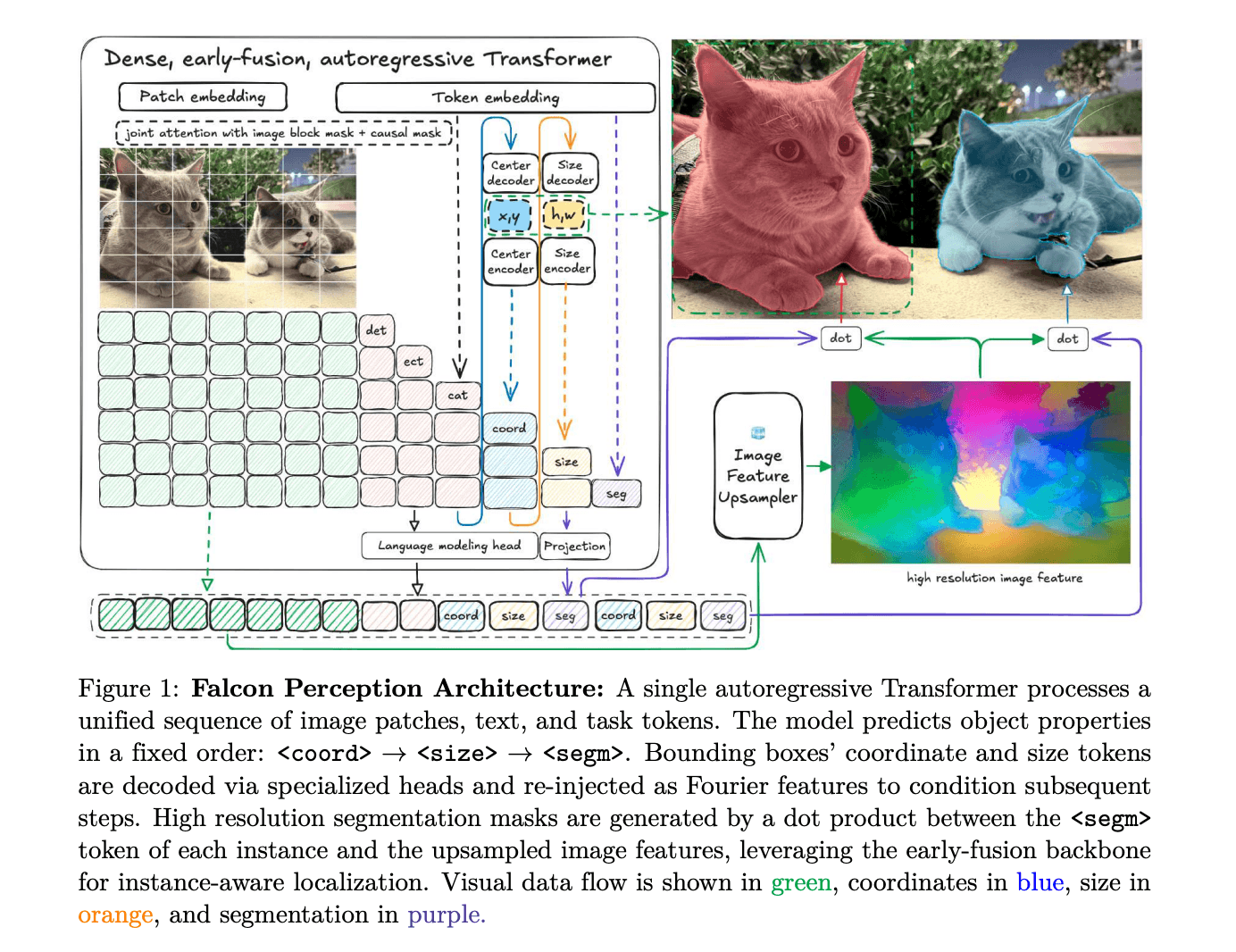
TII Releases Falcon Perception: A 0.6B-Parameter Early-Fusion Transformer for Open-Vocabulary Grounding and Segmentation from Natural Language Prompts
MarkTechPost

The house asked me a question
Dev.to

Precision Clip Selection: How AI Suggests Your In and Out Points
Dev.to


