
Optimal control of the future via prospective learning with control
arXiv stat.ML / 5/6/2026
💬 OpinionDeveloper Stack & InfrastructureIdeas & Deep AnalysisModels & Research
Key Points
- The paper argues that “optimal control of the future” should go beyond standard reinforcement learning (RL) by extending supervised learning to learning-to-control settings.
- It introduces “Prospective Learning with Control” (PLuC), showing that empirical risk minimization (ERM) can asymptotically achieve the Bayes-optimal policy under fairly general assumptions.
- The authors focus on a non-stationary, reset-free environment and demonstrate that this setting is where typical RL approaches break down or become inefficient.
- In a prospective-learning formulation tested on a 1-D foraging benchmark, modern RL methods (and even time-aware variants) converge dramatically more slowly than the proposed prospective foraging agents.
- The work provides an implementation via an open-source repository, enabling others to experiment with the PLuC framework.
Related Articles

Top 10 Free AI Tools for Students in 2026: The Ultimate Study Guide
Dev.to

SIFS (SIFS Is Fast Search) - local code search for coding agents
Dev.to
AI as Your Contingency Co-Pilot: Automating Wedding Day 'What-Ifs'
Dev.to
BizNode's semantic memory (Qdrant) makes your bot smarter over time — it remembers past conversations and answers...
Dev.to
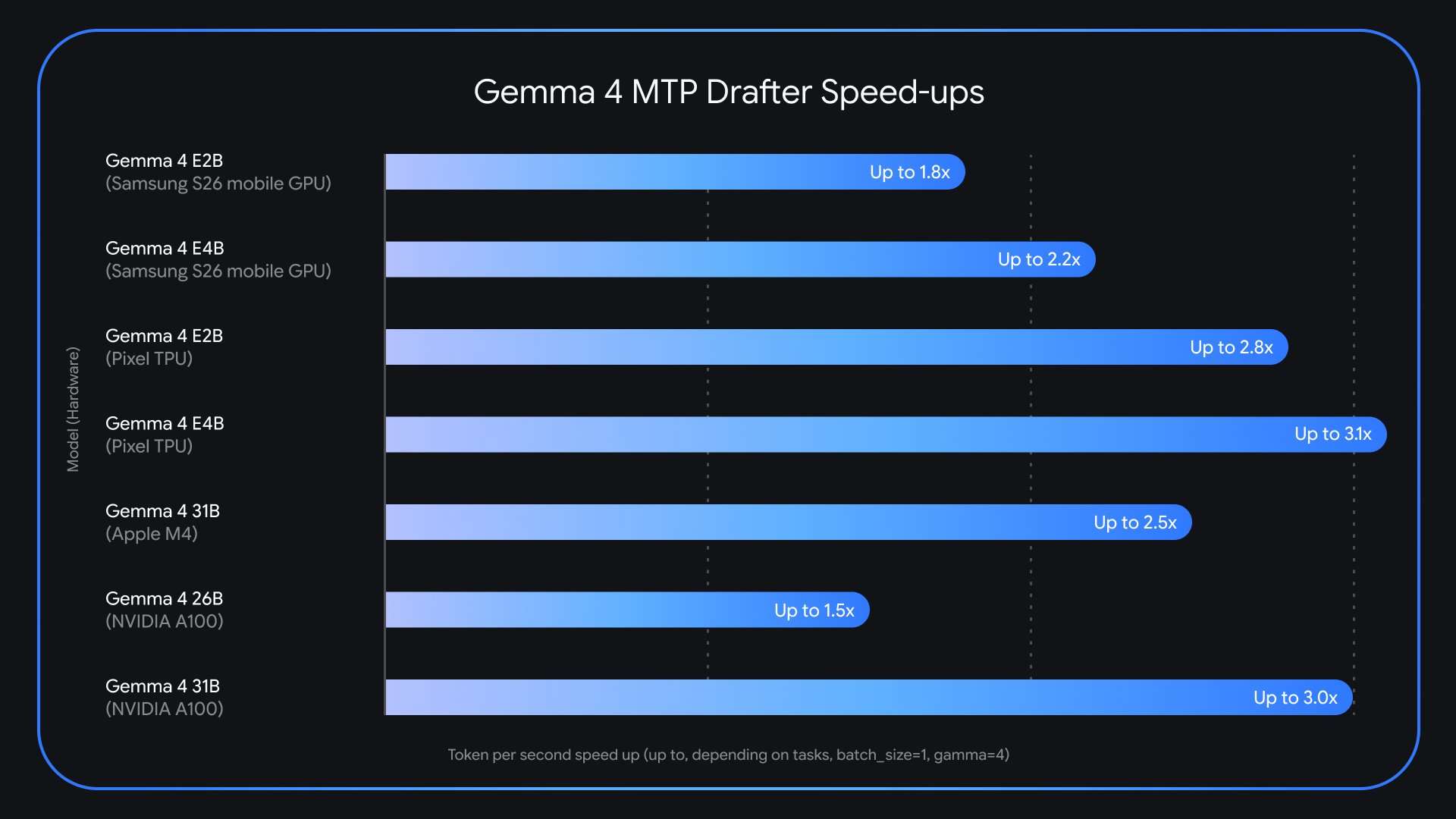
Google AI Releases Multi-Token Prediction (MTP) Drafters for Gemma 4: Delivering Up to 3x Faster Inference Without Quality Loss
MarkTechPost


