
Bridging MRI and PET physiology: Untangling complementarity through orthogonal representations
arXiv cs.CV / 4/9/2026
💬 OpinionSignals & Early TrendsIdeas & Deep AnalysisModels & Research
Key Points
- The paper argues that multimodal MRI–PET fusion should explicitly distinguish shared information from modality-specific information, because this clarifies each modality’s irreducible clinical contribution and can guide acquisition design.
- It proposes a subspace decomposition framework that treats fusion as orthogonal subspace separation (via representation geometry) rather than as simple latent translation between modalities.
- Using multiparametric MRI to train a non-spatial implicit neural representation (INR) that predicts PSMA PET uptake, the method introduces SVD-based projection regularization to enforce orthogonality between an MRI-explainable physiological “envelope” and an orthogonal residual.
- On 13 prostate cancer patients, the model shows that MRI-spanned components are absorbed into the learned envelope, while the orthogonal residual is strongest in tumor regions, implying PET contains signal aspects not recoverable from MRI-derived physiological descriptors.
- The approach yields a structured, mathematically grounded characterization of complementarity between PSMA PET and MRI, focused on what each modality can or cannot represent.
Related Articles

Black Hat Asia
AI Business
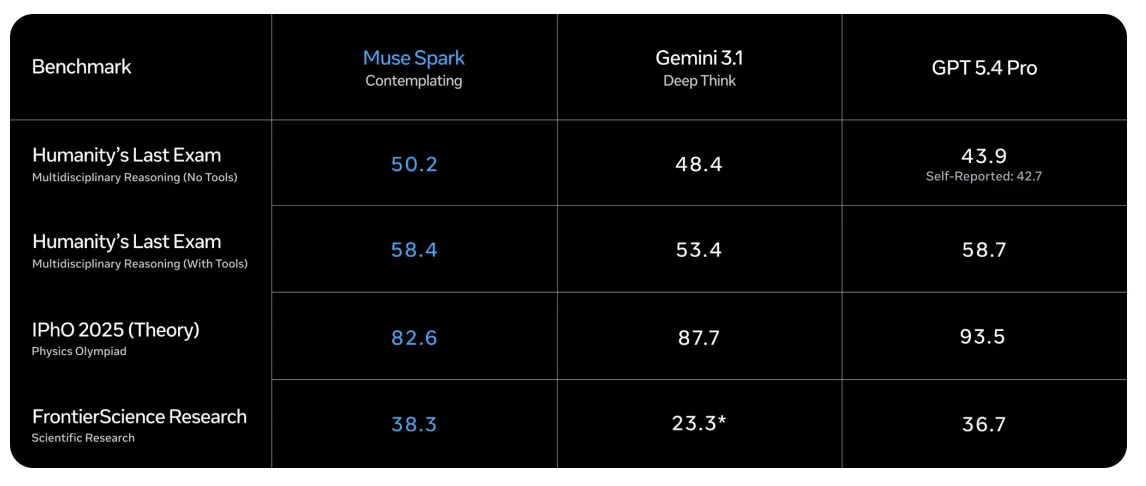
Meta Superintelligence Lab Releases Muse Spark: A Multimodal Reasoning Model With Thought Compression and Parallel Agents
MarkTechPost

Chatbots are great at manipulating people to buy stuff, Princeton boffins find
The Register
I tested and ranked every ai companion app I tried and here's my honest breakdown
Reddit r/artificial

Big Tech firms are accelerating AI investments and integration, while regulators and companies focus on safety and responsible adoption.
Dev.to


