
GLM-5V-Turbo: Toward a Native Foundation Model for Multimodal Agents
arXiv cs.CV / 4/30/2026
📰 NewsIdeas & Deep AnalysisModels & Research
Key Points
- The paper introduces GLM-5V-Turbo as a step toward “native” multimodal foundation models for agents, focusing on perception and action across heterogeneous inputs like images, video, webpages, documents, and GUIs.
- Unlike approaches that treat multimodality as an add-on interface, GLM-5V-Turbo integrates multimodal perception directly into reasoning, planning, tool use, and execution.
- It summarizes improvements spanning model architecture, multimodal training, reinforcement learning, expanded toolchain capabilities, and integration with existing agent frameworks.
- Reported results show strong performance in multimodal coding, visual tool use, and framework-based agent tasks, while maintaining competitive text-only coding ability.
- The authors emphasize practical development lessons, arguing that reliable end-to-end verification, multimodal perception, and hierarchical optimization are key for building effective multimodal agents.
Related Articles
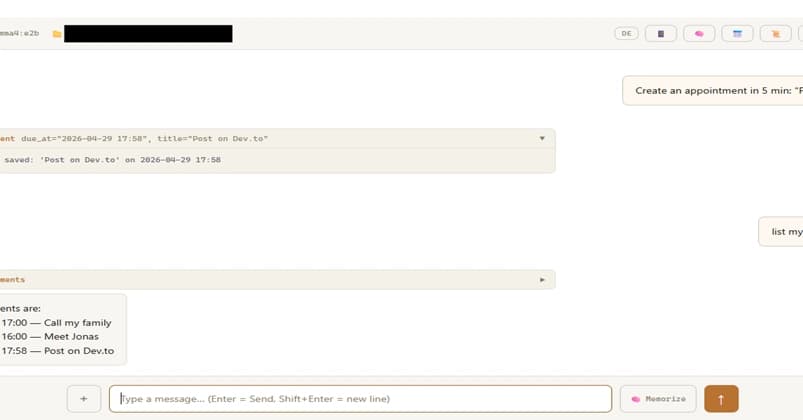
Building a Local AI Agent (Part 2): Six UX and UI Design Challenges
Dev.to
We Built a DNS-Based Discovery Protocol for AI Agents — Here's How It Works
Dev.to
Your first business opportunity in 3 commands: /register_directory in @biznode_bot, wait for matches, then /my_pulse to view...
Dev.to
Building AI Evaluation Pipelines: Automating LLM Testing from Dataset to CI/CD
Dev.to

Function Calling Harness 2: CoT Compliance from 9.91% to 100%
Dev.to


