
Translating Under Pressure: Domain-Aware LLMs for Crisis Communication
arXiv cs.AI / 4/30/2026
💬 OpinionIdeas & Deep AnalysisModels & Research
Key Points
- The paper addresses the challenge of producing timely, reliable multilingual crisis communication despite a lack of curated parallel data.
- It introduces a domain-adaptive pipeline that enlarges a small reference corpus by retrieving and filtering relevant data from larger general corpora.
- The authors fine-tune a small language model on the crisis-domain dataset and then use preference optimization to steer translations toward CEFR A2-level English.
- Evaluation (automatic and human) shows improved readability and maintained adequacy, suggesting simplified English plus domain adaptation can act as a workable emergency lingua franca.
- The approach is positioned as practical for situations where full multilingual coverage is not feasible due to resource constraints.
Related Articles
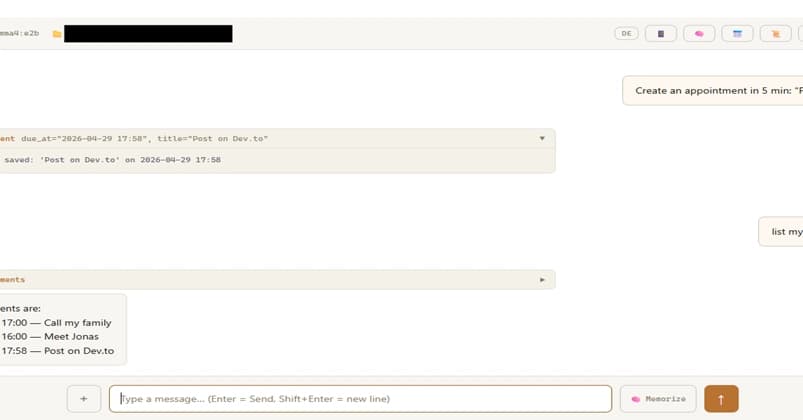
Building a Local AI Agent (Part 2): Six UX and UI Design Challenges
Dev.to
We Built a DNS-Based Discovery Protocol for AI Agents — Here's How It Works
Dev.to
Your first business opportunity in 3 commands: /register_directory in @biznode_bot, wait for matches, then /my_pulse to view...
Dev.to

Building AI Evaluation Pipelines: Automating LLM Testing from Dataset to CI/CD
Dev.to

Function Calling Harness 2: CoT Compliance from 9.91% to 100%
Dev.to


