
Zero-Shot to Full-Resource: Cross-lingual Transfer Strategies for Aspect-Based Sentiment Analysis
arXiv cs.CL / 4/30/2026
📰 NewsModels & Research
Key Points
- The paper evaluates aspect-based sentiment analysis (ABSA) across seven languages and four subtasks, addressing the field’s relative lack of non-English coverage despite recent transformer advances.
- It compares transformer architectures across three data regimes—zero-resource, data-only, and full-resource—using cross-lingual transfer, code-switching, and machine translation.
- Fine-tuned LLMs deliver the best overall results, especially for more complex generative ABSA tasks, while few-shot methods can nearly match them in simpler settings.
- Cross-lingual training on multiple non-target languages is most beneficial for fine-tuned LLMs, whereas code-switching yields the biggest gains for smaller encoder and seq-to-seq models.
- The authors release two new German datasets (an adapted GERest and the first German ASQP dataset, GERest) to support multilingual ABSA research.
Related Articles
We Built a DNS-Based Discovery Protocol for AI Agents — Here's How It Works
Dev.to
Building AI Evaluation Pipelines: Automating LLM Testing from Dataset to CI/CD
Dev.to

Function Calling Harness 2: CoT Compliance from 9.91% to 100%
Dev.to
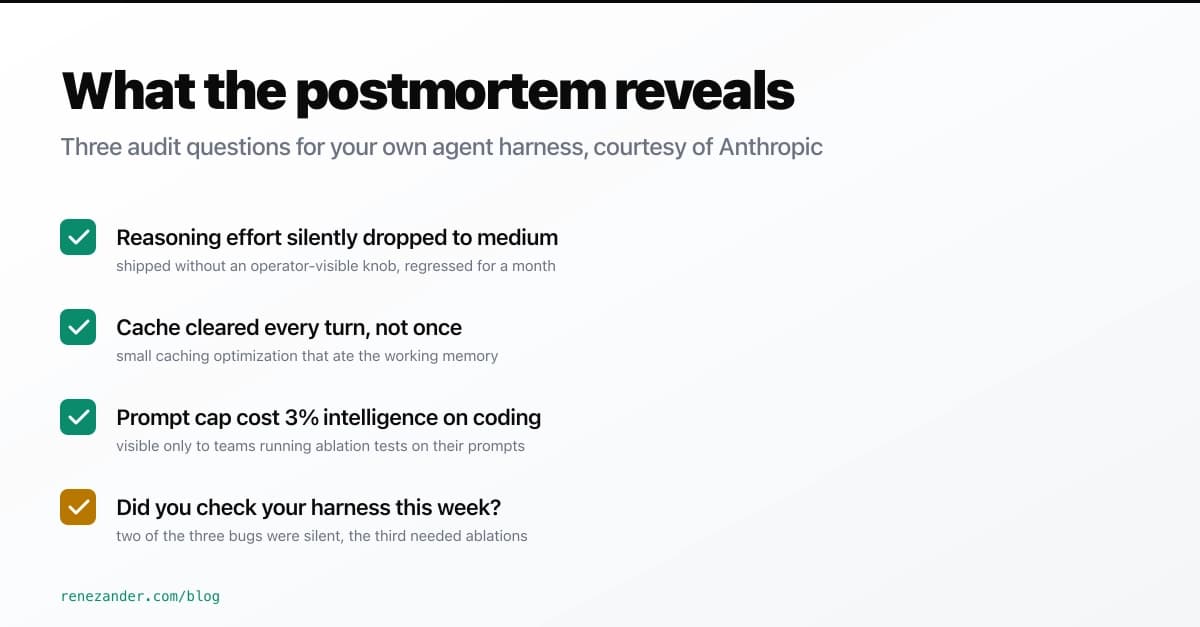
What Anthropic's April 23 Postmortem Reveals About Your Agent Harness
Dev.to
Fine-tuning YOLOv11 to detect stamps and signatures on banking documents - a practical walkthrough
Dev.to


